


Guide
Which sludge dewatering bag suits which quantity?
Which sludge dewatering bag suits which quantity? ➔ volume, working load and build height compared across all six versions. Read now!
Read guide →Starting price based on the lowest DHL weight tier (bis 6,99 kg). Final shipping costs depend on the total order weight and are calculated at checkout.
Couldn't load pickup availability
Need a custom size or a different version? Send us the key details directly via the form.
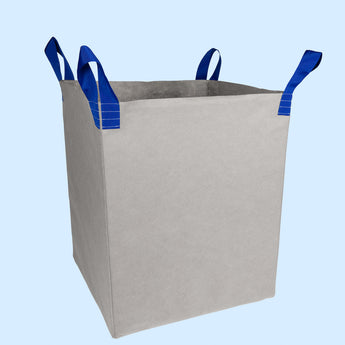
F-BAG is the product name of our free-standing sludge dewatering bags, and XL is the second largest of the four standard sizes. The F-BAG XL holds 0.8 m³ on a base area of one square metre and stands only 0.80 metres tall. That combination is what makes it a version in its own right rather than an intermediate size. All four sizes side by side.
The comparison with the XXL makes the point. Both bags have exactly the same base area of 1.00 by 1.00 metres. The difference lies solely in height, 0.80 against 1.25 metres. Choosing between them is therefore not a decision about floor space but about headroom. And headroom is the scarcer resource in a great many halls, under channels, beside settling tanks and under a crane hook.
Three situations come up again and again.
The filling point is fixed. A pipe outlet, a channel edge or a hose bracket sits at a given height. If the bag is too tall, filling has to happen from the side, which means splashing and uneven distribution. At 0.80 metres there is usually enough clearance above.
Lifting capacity is limited. A filled bag has to come straight up before it can move sideways. With an overhead crane that has tight hook height, or a forklift with limited lift, 45 centimetres of difference quickly becomes the deciding factor.
The location is built over. Under platforms, conveyors, cable trays or a mezzanine, every centimetre counts. Here the decision follows clear height, not volume. Flatter still is the custom version at 0.40 m.
Moving from size L at 0.5 m³ to 0.8 m³ means 60 per cent more volume. At the same time the base area grows from 0.72 to 1.00 square metres, so by a good third. The larger filter area helps the dewatering pattern, because the filter cake spreads across more surface and blinds off less quickly.
What does not follow from that is a guaranteed dewatering time or an assured throughput. Both depend on the sludge. What does follow is straightforward: for the same volume of sludge you need fewer bags, so fewer set-ups, fewer lifts and fewer disposal units. That is the commercial core of the size step.
You can choose 400, 600 or 900 kg. At 0.8 m³ of fill volume the arithmetic is stricter than with the L: a density of 1.2 t/m³ after dewatering already produces around 960 kg at full fill. Mineral sludges from concrete, stone or metal processing often sit in that range or above it.
For those materials 900 kg is the rating to take, and even then the fill height is worth watching. Anyone who orders 400 kg for mineral sludge will not be able to use the bag’s volume without putting the lift at risk. With lighter, organic or highly watery sludges the lower ratings are sufficient.
| Feature | Value |
|---|---|
| Usable volume | 0.8 m³ |
| Base area | 1.00 × 1.00 m |
| Height | 0.80 m |
| Working load | 400, 600 or 900 kg, selectable |
| Lifting loops | 280 mm overhang |
| Material | PP geotextile, thermally bonded, hydrophilic finish |
| Basis weight | 200 g/m² |
| Thickness | approx. 2.0 mm |
| Opening size | O90 100 µm |
| Flow rate, flat material | 80 l/s/m² at 50 mm water column; 135 l/s/m² at 100 mm |
| Use | single use |
| Delivery time | 1 to 2 working days |
| XL | XXL | |
|---|---|---|
| Usable volume | 0.8 m³ | 1.25 m³ |
| Base area | 1.00 × 1.00 m | 1.00 × 1.00 m |
| Height | 0.80 m | 1.25 m |
| Working load | 400 / 600 / 900 kg | 400 / 600 / 900 kg |
| Decisive when | filling height, hook height or clear height are limited | floor space is tight and height is available |
Most queries about this size are about the comparison with the larger model and about heavy, abrasive sludges.
Because the XXL is 45 centimetres taller. That affects filling from above, lifting with crane or forklift, and the route to the disposal point. Where the height is available, the XXL is more economical. Where it is not, the XL is the only option that still gives you a full square metre.
Rock flour, metal fines and grinding sludge are dewatered in F-BAGs regularly. Because sharpness, temperature and additives vary so widely, we check suitability before a new medium goes in and will suggest a trial with a single bag where that makes sense.
Until the usable volume is reached, until the permitted working load is reached, or until the flow has dropped so far that waiting no longer pays. Which of the three comes first depends on the sludge; the relationships are explained in the process guide. With fine sludges it is usually the flow, with heavy ones the load.
That depends on the internal dimensions. With a 1.00 by 1.00 metre base you need a clear internal size with a little to spare. Send us the dimensions of your holder and we will check whether a standard size fits or whether a custom bag makes more sense.
These details are taken automatically from the technical table in the product description.
Overview of all variants stored in the shop. Ordering still takes place through the variant selector above.
| load | Price | Availability |
|---|---|---|
| 600kg | 49,39 € 41,50 € net | Available |
| 900kg | 63,43 € 53,30 € net | Available |
Selection guidance and technical background for choosing and using the product correctly.
Which sludge dewatering bag suits which quantity? ➔ volume, working load and build height compared across all six versions. Read now!
Read guide →
How to dewater sludge in a filter bag ➔ set-up, filling, filter cake and filtrate explained, plus where the method stops. Read the guide!
Read guide →Your cart is currently empty.
Start Shopping


