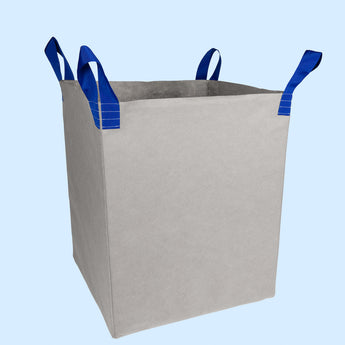
Sludge dewatering bag, 0.5 m³, WINKLER F-BAG L, three load ratings
A 0.5 m³ sludge dewatering bag with three working load ratings
The F-BAG range covers four free-standing sizes of sludge dewatering bags. With 0.5 m³ of usable volume on a base area of 0.90 by 0.80 metres and a height of 0.70 metres, the F-BAG L is the first version where you choose between three working load ratings: 400, 600 or 900 kg.
That choice is not a formality. It decides whether the filled bag hangs safely from its loops or whether you have to shovel material out before you can move it. The rule of thumb is short: volume decides how much goes in, density decides what it weighs afterwards, and the load rating has to match the second figure rather than the first.
400, 600 or 900 kg: choosing the working load rating
At 0.5 m³ of fill volume, the mass you should expect follows from the density of the dewatered material. As a rough guide:
| Starting material | Approx. density after dewatering | Mass at full fill | Sensible rating |
|---|
| light organic sludges | around 0.8 t/m³ | around 400 kg | 400 kg |
| mixed mineral sludges | 1.0 to 1.3 t/m³ | 500 to 650 kg | 600 kg |
| heavy mineral sludges, stone, metal fines | 1.5 t/m³ and above | 750 kg and above | 900 kg |
These figures are orientation, not a commitment. Actual density depends on grain size, residual moisture and conditioning. If you are unsure, dewater one batch, weigh the bag and note the number for every future order. It takes half an hour and it makes every subsequent sizing decision safe. The full calculation is set out in the size guide.
If you calculate tightly, do not fill the bag to the top edge. If you take the next rating up, you have headroom and can use the full fill height. Both are defensible. It should simply be a deliberate decision rather than an accident.
Where the 0.5 m³ industrial sludge filter bag is used
Size L tends to be used where dewatering is a fixed part of a routine rather than the exception. Vehicle and machine wash bays where the sludge trap is emptied on a schedule, which is the classic case of wash bay sludge dewatering. Concrete processing with saw and grinding water. Recycling operations with recurring process water. Municipal and decentralised plants with manageable batches.
The base area of 0.90 by 0.80 metres is a practical figure in its own right: it fits on a Euro pallet, which makes recovery and transport noticeably simpler. The filled bag can be moved with a forklift without overhanging the pallet edge.
Filter material, filling and filter cake
Like every free-standing size, the L is made from thermally bonded polypropylene geotextile with a hydrophilic finish, 200 g/m² basis weight, around 2.0 millimetres thick, with a characteristic opening size O90 of 100 µm. The strap loops stand 280 millimetres proud. The bag is open at the top and can be filled by hose, pipe, pump or from a container.
The documented flow rates of 80 l/s/m² at 50 mm water column and 135 l/s/m² at 100 mm water column describe unloaded textile. As soon as a filter cake builds, throughput falls. That is not a defect, it is how the process works: the cake takes over part of the filtration and holds back particles the textile alone would have passed. The process guide follows that curve in detail.
Technical data, sludge dewatering bag 0.5 m³
| Feature | Value |
|---|
| Usable volume | 0.5 m³ |
| Base area | 0.90 × 0.80 m |
| Height | 0.70 m |
| Working load | 400, 600 or 900 kg, selectable |
| Lifting loops | 280 mm overhang |
| Material | PP geotextile, thermally bonded, hydrophilic finish |
| Basis weight | 200 g/m² |
| Thickness | approx. 2.0 mm |
| Opening size | O90 100 µm |
| Flow rate, flat material | 80 l/s/m² at 50 mm water column; 135 l/s/m² at 100 mm |
| Use | single use |
| Delivery time | 1 to 2 working days |
Questions we are asked about the 0.5 m³ bag
Because this is the first size where a load rating has to be chosen, most questions are about exactly that.
Which rating do I take if I do not know the density?
For mineral sludges, 600 kg covers most cases. For rock flour, metal fines or material that compacts heavily, 900 kg is the safe answer. After the first weighed batch you will know precisely.
What happens if I exceed the working load?
The working load refers to lifting the bag safely by its loops. Beyond it, recovery is no longer covered. In that case the bag has to be partly emptied before lifting, which costs time and cancels out the advantage of the method.
Is the L suitable for sewage sludge?
Yes, for small and decentralised batches it is used for exactly that. Which size and rating suit you depends on solids content, conditioning and batch quantity. As a replacement for a centrifuge, screw press or chamber filter press in continuous duty, bag dewatering is not the right tool.
Can the water that comes out go to the drain?
Not without checking. The bag separates solids, it does not treat effluent. Whether the filtrate may be discharged depends on the original medium and on local requirements, and that is for the operator to establish.
How does the L differ from XL and XXL?
The L has a smaller footprint and is lower. XL and XXL both have a full square metre of base area and differ from each other only in height. If your standing space is narrow, the L is the better fit even where the volume would be comparable. For the comparison: size XL with 0.8 m³.