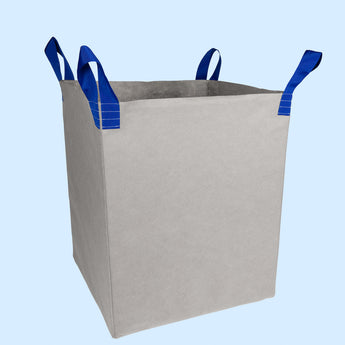
Sludge dewatering bag, 1.25 m³ on one square metre, WINKLER F-BAG XXL
A 1.25 m³ sludge dewatering bag on a single square metre
F-BAG is the product name of our free-standing sludge dewatering bags, and XXL is the largest standard size in the range. The WINKLER F-BAG XXL holds 1.25 m³ and stands on exactly one square metre. That is the defining property of this size: it gets the most out of a footprint that is usually in short supply. It does so through build height, 1.25 metres.
Against size XL, which has the same base area but stands only 0.80 metres tall, you gain around 56 per cent more usable volume without giving up a single square centimetre of floor. Where the location is fixed and the quantity is rising, that is the most direct lever available.
What the WINKLER F-BAG XXL is built for
The XXL is the right choice where larger batches occur regularly and the effort per bag starts to count. Every bag means setting up, positioning, filling, waiting, lifting, transporting and disposing. For the same quantity of sludge, that effort is spread across fewer units.
Established applications include vehicle and rail vehicle wash installations where sludge traps are emptied on a schedule, which is the standard case of wash bay sludge dewatering; concrete plants and concrete processing with saw, grinding and flushing water; recycling operations with recurring process water; drilling slurries from quarrying and concrete drilling; road sweepings from street cleaning; and industrial side streams where solids are separated before further treatment.
Check before you order: filling height, hook height, stability
The height of 1.25 metres is the reason for the volume and at the same time the only real constraint. Three points are worth a look before you order.
Filling. The bag is open at the top. The mixture should be able to enter from above without hose or pipe having to reach over the top edge. Check the height of your outlet.
Recovery. Lifting the filled bag needs hook height. Add build height, slings and ground clearance. Where hall height is tight, the XL at 0.80 metres is the safer option.
Stability. A slim, tall bag needs level, load-bearing ground. On uneven hardcore or in a hollow with a fall to one side, a filled bag can lean.
Working load: at 1.25 m³ this is the limiting factor
At 1.25 m³ of fill volume the working load becomes the constraint quickly. A dewatered sludge at 0.8 t/m³ already produces around a tonne at full fill. Mineral sludges sit well above that.
In practice that means the limit is not the volume but the mass. You will not fill the bag to the top edge, you will fill it to the permitted weight. Plan for that from the start, choose the 900 kg rating and mark a fill height for the people on site. Leave it to chance and you will eventually be standing in front of a bag you are not allowed to lift.
For orientation, in each case at a full fill of 1.25 m³:
| Density after dewatering | Calculated mass | Consequence |
|---|
| 0.7 t/m³ | around 875 kg | 900 kg rating, full fill possible |
| 1.0 t/m³ | around 1.250 kg | 900 kg rating, limit the fill height |
| 1.5 t/m³ | around 1,875 kg | 900 kg rating, well below half fill height |
From densities of about 1.0 t/m³ upwards it is worth asking whether two smaller bags are the more practical answer. They can be lifted one at a time and they actually use their volume. The size guide works that through.
How the dewatering runs
The sludge and water mixture goes in from above, by hose, pipe, pump or from a collection tank. Water leaves across the wetted textile area, the solids stay behind and form a filter cake. Over time that cake increases retention and lowers the flow rate.
The filtrate that comes out has to be collected. Whether it may be discharged, needs further treatment or has to be disposed of depends on the original medium and on local requirements. Once dewatering is far enough advanced, the bag is moved by its four strap loops within the chosen working load. Bag and contents are disposed of together.
We cannot commit to a dewatering time. It depends on solids content, particle and floc size, temperature, conditioning and how the cake builds. For a sludge you have not run before, a trial with one bag is the most reliable basis for planning. The process guide describes the full sequence.
Technical data, sludge dewatering bag 1.25 m³
| Feature | Value |
|---|
| Usable volume | 1.25 m³ |
| Base area | 1.00 × 1.00 m |
| Height | 1.25 m |
| Working load | 400, 600 or 900 kg, selectable |
| Lifting loops | 280 mm overhang |
| Material | PP geotextile, thermally bonded, hydrophilic finish |
| Basis weight | 200 g/m² |
| Thickness | approx. 2.0 mm |
| Opening size | O90 100 µm |
| Flow rate, flat material | 80 l/s/m² at 50 mm water column; 135 l/s/m² at 100 mm |
| Filling | open top, no fixed inlet connection |
| Use | single use |
| Delivery time | 1 to 2 working days |
Questions we are asked about the 1.25 m³ bag
With the largest standard size, the questions are usually about limits: continuous duty, load ratings, installation dimensions and the difference from a bulk bag.
Can the XXL be filled continuously?
It can be filled in stages over a longer period, as long as volume and working load are respected. Continuous duty with a constant inflow is a different matter, and that is what decanters and chamber filter presses are built for. A filter bag works in batches.
Why does the 900 kg version cost noticeably more?
The higher working load comes from reinforced straps, additional stitching and reinforcing bands. That is material and manufacturing effort, and it goes directly into load capacity.
Will the XXL fit a standard container or skip?
With one square metre of base and 1.25 metres of height, that depends on the internal dimensions and the clear height. Height is usually the problem. Check the dimensions of your holder before ordering. If nothing fits, we make bags to your measurements.
What is the difference between this and a bulk bag?
A bulk bag or FIBC is a transport container for dry bulk material with its own testing and certification logic. The F-BAG is a filter medium: it lets water pass through the wall deliberately. The two look similar and do different jobs. The F-BAG is not designed to meet FIBC transport requirements.
Can we test the XXL first?
Yes, and with a new medium that is the sensible way in. A single bag with a real batch shows dewatering behaviour, residual mass and handling better than any calculation.