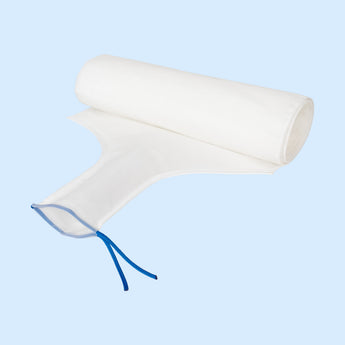
Coarse pond filter bag, 400 µm
Built for what autumn puts in the pond
After leaf fall, a good part of what lies on the bottom of a pond is leaves, needles, dead plant material and twigs. That material is bulky, sometimes sharp, and it closes a fine bag within minutes.
This is the grade for that job. At 285 micrometres the fabric is more than twice as thick as the 100 µm version, and with 52 per cent open screen area it has the most through-flow surface in the range. It takes a lot, stays open longer and copes with the occasional twig.
What 52 per cent open screen area actually means
This figure is the real difference between the grades, so it is worth a paragraph.
Open screen area is the proportion of the fabric surface made up of openings. In the 400 µm fabric it is 52 per cent; in the 100 µm fabric it is 33 per cent. Put plainly, the coarse fabric has around half as much again in through-flow surface.
In practice that means it loads more slowly and works for longer before water starts to back up. What it does not mean is that a particular number of litres passes per minute. Actual throughput depends on the vacuum, the hose run, the type of sludge and how loaded the bag already is. We do not publish flow figures.
When a pond pre filter is the right call
Three situations point clearly to this grade.
Leaf input. After autumn, or under trees, there is a lot of coarse organic material on the bottom. A fine bag would be closed after the first metre of vacuuming.
First stage of a two-stage clean. On a heavily silted pond, a coarse pond pre filter takes a great deal of load off the finer stage. Coarse first, fine second: the solids are spread across two bags, and the fine one stays permeable longer.
First clean after a long gap. Where a pond has not been de-silted for several years, the solid load is high and uneven. Starting coarse is almost always the right order.
The other way round: if your pond is maintained regularly and the load is manageable, go straight to the 150 µm grade. A coarse bag lets finer material through, and that material goes back into the pond.
Sizes, opening and closure
| Feature | Value |
|---|
| Material | monofilament polyester screen fabric |
| Mesh aperture | 400 µm, range 380 to 420 |
| Open screen area | 52 %, range 49 to 55 |
| Fabric thickness | 285 µm, range 271 to 299 |
| Fabric weight | 105 g/m² |
| Sizes | 2,500 × 440 mm, 5,000 × 440 mm, 5,000 × 880 mm |
| Opening | 70 or 105 mm, depending on variant |
| Closure | open, or with a full-length zip |
| Use | cleanable and reusable |
The opening has to match the discharge of your vacuum. Measure the outside diameter of the hose end or spigot and choose accordingly. For anything outside these dimensions we make the bag to your measurements.
One point of terminology, because it turns up in search: the 400 refers to the mesh aperture in micrometres, not to a bag width in millimetres. A 400 micron pond filter bag is this product; a 400 mm bag is not a size we make, and the two get confused often enough that it is worth saying. Written out in full, this is a pond vacuum filter bag at 400 micron mesh aperture, fitted to the discharge of a pond vacuum.
Emptying and cleaning
Coarse material mostly shakes out, which is the practical advantage of this grade. After that, turn the bag inside out and rinse it with clean water.
Pay particular attention to the fabric in the bottom third when you inspect it. That is where the heaviest material collects, and that is where damage happens if a stone or a hard twig has been lifted with the sludge. Small holes are less obvious in a coarse fabric than in a fine one, and they have exactly the same effect.
What the coarse grade does not do
It holds back what is larger than its mesh aperture. Fine sludge, algae residue and suspended solids pass through the fabric and return to the pond with the water. If the water is still cloudy after cleaning, that is not a fault of the bag; it is the grade you chose.
Anyone wanting clearer water works in two stages or picks a finer grade from the start. Completely clear water is not achieved by any grade, because part of the cloudiness comes from particles no textile filter of this design captures.
Questions about the 400 µm pond vacuum filter bag
The recurring question is whether the coarse grade is enough on its own.
Is the 400 µm bag enough for a whole pond clean?
For the coarse fraction, yes. Fine sludge and suspended solids pass through and stay in the pond. If you want clearer water, follow with a finer grade.
When is a two-stage clean worth it?
When there is a lot of material and you still want a fine result. The coarse bag takes the main load, so the fine bag stays permeable longer. Without a first stage, a 100 µm bag closes quickly under a heavy load.
Does it cope with twigs and stones?
The fabric is 285 micrometres thick, considerably more than the finer grades, and correspondingly more robust. We still give no assurance for sharp material: a pointed twig or an angular stone can pierce any textile fabric of this kind. A coarse strainer at the suction head reduces that risk substantially.
Does water pass through faster?
The fabric has the largest open screen area in the range at 52 per cent, so it loads more slowly. We cannot derive a flow rate in litres per minute from that, because the vacuum, hose length and type of sludge all have a say.
Will it fit my pond vacuum?
The discharge diameter decides. Measure the outside diameter of the hose end or spigot and tell us the length you want, and we will match the variant.
Can I get leaves out without a vacuum at all?
For floating leaves a net is enough and is the simplest method. What has already sunk and mixed with sludge will not come out that way.