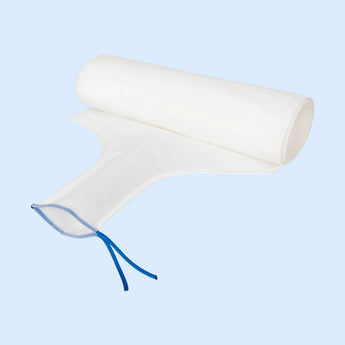
Pond vacuum filter bag, 150 µm
The bag the vacuum discharges into
A pond vacuum lifts a mixture of sludge and water off the bottom of the pond. Something has to catch the solids and let the water run back, and that something is this bag. It goes on the discharge hose or outlet of the vacuum, at the edge of the pond, and the water leaves through the fabric while the sludge stays inside.
Note what this is not. It is not a media bag that you fill with foam or ceramic and drop into a filter chamber, and it is not a mesh sleeve that goes around a pond pump. Search results mix all three under similar names. This is the bag at the discharge end.
150 µm is the grade most ponds want
Of the three grades in the range, this is the one that suits ordinary maintenance. Fine enough to hold back pond sludge, algae residue and moderate debris. Open enough that it does not close up in the first few minutes.
Whether you call it a pond vacuum sludge bag, a pond sludge filter bag or a 150 micron pond filter bag, it is the same part. It sits between the coarse 400 µm grade and the fine 100 µm grade. Not the right answer in every case, but the obvious one when the pond is in normal condition and you do not want to work in two passes.
Three sizes and two opening diameters
This grade has the widest choice in the range.
| Feature | Value |
|---|
| Sizes | 2,500 × 440 mm, 5,000 × 440 mm, 5,000 × 880 mm |
| Opening | 70 or 105 mm, depending on variant |
| Closure | open, or with a full-length zip |
| Material | 100 % polyethylene, monofilament, plain weave |
| Yarn diameter | 0.15 mm |
| Fabric weight | 115 ± 20 g/m² |
| Filter grade | 150 µm |
| Use | cleanable and reusable |
Length is filter area. A five-metre bag has considerably more wettable surface than a 2.5-metre one, spreads the solids out better and needs interrupting less often. Where the bank is tight or the bag has to be carried afterwards, the shorter version is easier to handle.
The opening has to match the discharge of your vacuum. Measure the outside diameter of the hose end or spigot the bag will be fitted to, then choose 70 or 105 mm.
What 150 µm means for this filter bag
The 150 µm figure identifies the filtration grade of this filter bag within our pond range. It sits between the coarse 400 µm bag and the finer 100 µm version.
For practical selection, this grading is what matters. The 150 µm bag is intended for normal pond contamination, where pond sludge, algae residue and medium-sized solids should be retained without immediately moving to the finest grade. With a lot of leaves and coarse plant material, the 400 µm bag is the better first stage. For finer suspended solids, the 100 µm bag can be used afterwards.
The 150 µm figure is not a guaranteed cut-off. Actual retention also depends on particle shape, sludge composition, water volume and the loading state of the fabric. During cleaning, a sludge layer builds up on the inside of the bag. This changes the retention behaviour and gradually reduces the water flow through the fabric.
Open or with a zip
Both closures are available, and the choice is purely about handling.
The open version is untied at the end and emptied. It is the simpler build and has one component fewer that can wear.
The zip version opens along its full length. That makes emptying much easier when the sludge is heavy or has set, and it makes rinsing the fabric from the inside far more thorough.
Cleaning and reusing the bag
After use, empty the bag, turn it inside out and rinse it with clean water. Turning it matters: rinsing from the inside lifts particles out of the weave instead of driving them further in.
Then check fabric, seams, opening and, if fitted, the zip. As long as everything is undamaged, the bag goes back into service.
We do not quote a number of uses. It depends on how dirty the pond is, on how carefully the bag is rinsed and on whether it has been dragged over stones or edges.
What the bag does not do
It filters mechanically. Dissolved substances, nutrients and bacteria stay in the water, and the biology of the pond does not change because of it. If you are trying to get algae growth under control, the nutrient input is where to start.
The pond vacuum itself is not included. WINKLER makes the filter bags, not the machines.
Questions about the 150 µm pond vacuum filter bag
Almost every enquiry is about choosing a size or comparing the grade with the other two.
Which size do I need?
Two things decide: how much you lift in one session, and how much room there is at the bank. For larger ponds or longer sessions the five-metre version makes sense, because it holds more filter area and needs interrupting less. For smaller ponds 2.5 metres is enough.
Will it fit my pond vacuum?
That depends on the discharge diameter. Openings of 70 and 105 mm are available. Measure the outside diameter of the hose end or spigot. For anything different we make the bag to your dimensions.
What does the 150 µm rating mean?
150 µm is the filtration grade of this filter bag within the WINKLER pond range. It positions the bag between the coarse 400 µm and the finer 100 µm version. It is not a guaranteed cut-off; actual retention also depends on the sludge composition, particle shape and the filter cake that builds up during use.
When should I use 100 or 400 µm instead?
With a lot of leaves, plant debris and coarse material, the 400 µm grade is the better first pass. If cloudiness remains after cleaning and you want to catch finer solids, the 100 µm grade is the second pass. Heavily silted ponds are worth doing in two stages.
Can I use the bag more than once?
Yes, as long as fabric, seams, opening and closure are undamaged. Empty it, turn it inside out, rinse with clean water and inspect. We do not give a fixed number of uses.
Does the water really run back into the pond?
Yes, that is the principle. The vacuum moves the sludge and water mixture into the bag, the solids stay behind and the water drains away. The pond does not have to be refilled. It is not water treatment.