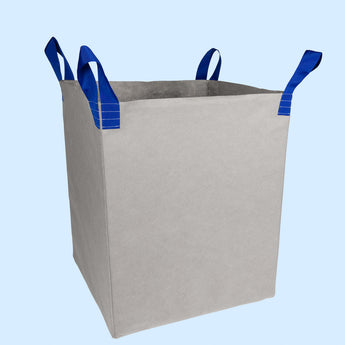
Sludge dewatering bag, 0.125 m³, WINKLER F-BAG M
A 0.125 m³ sludge dewatering bag that stands on a quarter of a square metre
F-BAG is what we call our free-standing sludge dewatering bags, and M is the smallest of the four volume sizes. The F-BAG M measures 0.50 by 0.50 metres in plan, stands 0.50 metres high and holds 0.125 m³. Its working load is 400 kg. Unlike L, XL and XXL there is no choice of load rating here, because at this volume the bag already reaches a sensible limit.
In practice the figure that usually decides the purchase is not the volume but the footprint. A quarter of a square metre fits beside a machine, into the corner of a wash bay or onto a pallet without blocking a walkway. Anyone who has tried to place a bag with a full square metre of footprint in a tight workshop knows the difference.
Small batches and tight floor space: where size M pays off
Size M suits operations where dewatering is a recurring task rather than a daily one. Maintenance on a settling tank. A cleaning cycle that empties a sludge trap. A morning of core drilling that produces drilling slurry. A small side stream running alongside the main process.
The honest arithmetic matters here: 0.125 m³ is 125 litres. A sludge with a high water content fills that faster than the figure suggests, because at the start the water still stands in the bag before it works its way out through the filter area. If you regularly have more than about a hundred litres per batch, the 0.5 m³ size is the more economical choice, because the effort of setting up, lifting and disposing is spread across more solids.
Working load up to 400 kg: the limit that actually decides
Volume tells you how much goes in. Working load tells you how much you are allowed to lift afterwards. These are two different numbers, and the second one is the one people underestimate.
A mineral sludge with a high solids content can weigh well over a tonne per cubic metre once dewatered. At 0.125 m³ that still leaves you inside the 400 kg limit. With heavy sludges from stone processing or metal grinding it is still worth a check: estimated density of the dewatered material multiplied by the fill volume. If the result comes close to 400 kg, do not fill the bag to the top edge. How volume, density and working load are weighed against each other is set out in the size guide.
How the dewatering runs
The bag is open at the top. There is no defined inlet connection, and none is needed. Filling can be done by hose, pipe, pump, bucket or straight from a collection tank. Water leaves across the whole wetted area, the solids stay behind and gradually form a filter cake. That cake is part of the filter: over time it holds back particles that would have passed at the beginning, and it lowers the flow rate as it does so.
The bag needs level, load-bearing ground and a way of catching the filtrate that comes out. What happens to the filtrate afterwards depends on the original medium. It is not automatically suitable for the drain, the ground or a watercourse. Set-up, filter cake and removal are described in full in the process guide.
Filter material: PP geotextile with O90 100 µm
All free-standing sizes use the same material: a thermally bonded polypropylene geotextile with a hydrophilic finish, a basis weight of 200 g/m² and a thickness of around 2.0 millimetres. Its characteristic opening size O90 is 100 µm.
O90 is not a separation limit. The figure describes the pore distribution of the textile and says that 90 per cent of the pores are smaller than that value. What is actually retained is decided by the combination of particle size, floc structure and the filter cake that builds up. For the flat material, flow rates of 80 l/s/m² at 50 mm water column and 135 l/s/m² at 100 mm water column are documented. Those values apply to unloaded textile and do not describe the performance of a filled bag.
Technical data, sludge dewatering bag 0.125 m³
| Feature | Value |
|---|
| Usable volume | 0.125 m³ |
| Base area | 0.50 × 0.50 m |
| Height | 0.50 m |
| Working load | up to 400 kg |
| Lifting loops | 280 mm overhang |
| Material | PP geotextile, thermally bonded, hydrophilic finish |
| Basis weight | 200 g/m² |
| Thickness | approx. 2.0 mm |
| Opening size | O90 100 µm |
| Flow rate, flat material | 80 l/s/m² at 50 mm water column; 135 l/s/m² at 100 mm |
| Filling | open top, no fixed inlet connection |
| Use | single use |
| Delivery time | 1 to 2 working days |
Questions we are asked about the 0.125 m³ bag
With the smallest size, most queries come down to two things: whether the volume is enough, and what the working load means in practice.
Is 0.125 m³ enough for my batch?
Work with the volume of the sludge and water mixture, not with the solids fraction alone. If you regularly exceed 100 litres per run, size L will serve you better. For occasional small quantities, M is the cheaper and easier option to handle.
Can I run several bags side by side?
Yes, and where the quantity varies a lot that is often more sensible than going one size up. Two M bags occupy half a square metre and can be lifted individually, which is a real advantage where lifting capacity is limited.
Why is there no 600 or 900 kg version of size M?
Because 0.125 m³ is hard to load past 400 kg even with very heavy material. A higher load rating would add cost without adding practical use.
How long does dewatering take?
We cannot give you a dependable figure. It depends on solids content, particle size, viscosity, temperature and how the cake builds. With fine, silty sludges it can take considerably longer than with coarse material. For a sludge you have not run before, we recommend a trial.
How do I lift the filled bag?
By the four strap loops, which stand 280 millimetres proud of the bag. Lifting equipment and slings have to match the actual load, not the nominal working load of the bag. Weighing beats estimating every time. If the sizing is unclear we will go through it with you.