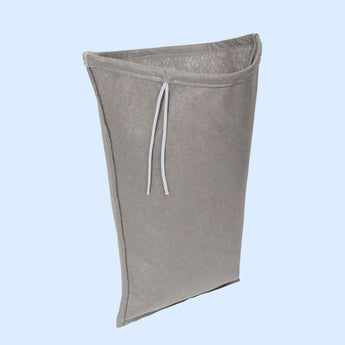
Microplastic filter bag for road and yard drains, 70 µm
A finer bag for the same catch basket
This is the finer of the two textile inserts for road and yard drains. It fits the same catch baskets as the 100 µm version, uses two layers of polypropylene needle felt instead of one, and is designed around a nominal 70 µm.
Length options run from 0.49 to 0.84 m, which covers the common gully pot forms A4, B1, C3 and D1 as well as yard gullies. The right length is decided by the depth of the basket, not by the drain above it.
What a road drain microplastic filter can honestly claim
This is the part that needs saying plainly, because the market around microplastics is full of claims that do not survive contact with a data sheet.
The bag retains solid particles above its retention range. Road-borne particulate material includes tyre and brake wear, fragments of road marking, weathered plastic and mineral dust, and a share of that material is coarse enough to be held by a 70 µm textile. That is a real contribution and it is measurable in what comes out of the bag.
What it is not: a complete microplastic barrier. A significant fraction of road-borne microplastic is finer than 70 µm, and no textile at this rating retains it. The bag also does not retain dissolved substances, polycyclic aromatic hydrocarbons or heavy metals in solution. Anyone who tells you a filter bag removes those is selling something else.
We would rather set that out here than have it come up after installation. The background, including why a micron figure cannot be converted into a treatment efficiency, is covered in the guide.
Tyre wear particles and where they end up
Tyre wear is the largest single source of road-borne particulate plastic, and a car park or a road surface delivers it into the drain with every rain event after a dry spell.
A tyre wear particle filter at the gully catches the coarser end of that material at the point where it enters the drainage system, before it reaches a watercourse or an infiltration structure. That is the argument for fitting one, and it is a source-control argument rather than a treatment argument. It works best where the drain serves a defined surface with known traffic: a yard, a car park, a service area, a loading bay.
Two layers, and what that does to the flow
The two-layer construction handles loading differently from a single dense fabric. The outer layer takes the coarser material and spreads it, the inner layer catches what passes. Documented flow for the flat material is 120 l/s/m² at 100 mm water column, against 135 l/s/m² for the 100 µm single-layer version.
That difference is worth reading correctly. The finer bag starts slightly slower and, because it retains more, it loads sooner. In a drain that carries a high sediment load, a 70 µm bag will need servicing more often than a 100 µm bag in the same position. Choosing the finer version is therefore a decision about the servicing regime as much as about the retention.
Technical data, microplastic filter bag 70 µm
| Feature | Value |
|---|
| Material | Polypropylene needle felt, two-layer |
| Filtration rating | nominal 70 µm |
| Length | 0.49 to 0.84 m depending on version |
| Opening width | 0.64 to 0.645 m |
| Weight | approx. 0.20 kg |
| Flow, flat material | 120 l/s/m² at 100 mm water column |
| Suits | gully pot forms A4, B1, C3, D1 and yard gullies |
| Use | consumable |
Questions about the microplastic stormwater filter
How much microplastic does it actually retain?
We do not publish a retention percentage, because it would depend on the particle size distribution at your specific location and there is no test result behind it. What we can say is that the bag holds solid particles above its retention range and that a share of road-borne microplastic falls below it.
Which length do I need?
Measure the internal depth of the catch basket. The versions run from 0.49 to 0.84 m and are matched to the common gully pot forms. If you know your gully pot form, that usually settles it.
Is this the filter for washing machine microplastics?
No. This is a drainage product for road and yard gullies. Domestic laundry filters are a different product category entirely.
Does it help meet regulatory requirements?
A filter insert can be one measure within a wider drainage concept. Whether a scheme meets a given requirement depends on the design, the hydraulics, the maintenance regime and the evidence, not on a product. We do not certify compliance and neither does the bag.
How does it compare with the 100 µm version?
Finer retention, slightly lower flow, faster loading and therefore more frequent servicing. Use the 100 µm bag as the standard across a gully stock and the 70 µm bag where finer retention is a specific objective.
Does it retain oil or hydrocarbons?
No. This is a particle filter. Hydrocarbon separation is a different technology and belongs in a different part of the drainage design.