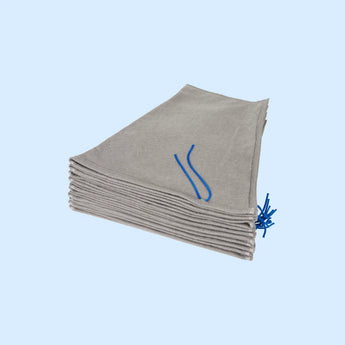
Gully bag for catch baskets and road gullies, 100 µm
A gully bag that adapts to the bucket you already have
Road gullies, yard drains and car park drains are built much the same way: a grating, a catch basket underneath, and below that the connection to sewer or soakaway. The basket holds coarse material. Everything finer passes straight through.
This gully bag goes into that existing basket. It is textile rather than rigid, so it takes the shape of the bucket instead of requiring a particular one. That single property is what makes it work across a stock of gullies that were installed over decades and are not all the same.
No fixings, no brackets, no modification. The bag is placed in the basket, the top edge folds over the rim, and the basket goes back under the grating.
What road gully bags hold back
At a nominal 100 µm the bag is a general solids filter. In practice that means sand, grit, sediment washed off the surface, leaf fragments, seed cases, cigarette ends, packaging fragments and the mineral material that arrives after every dry spell followed by rain.
Road gully filter bags and storm drain filter bags are the same product under two names, the first British and the second international. That is the honest description of what a storm drain debris filter does. What it does not do is retain dissolved substances, hydrocarbons in solution or heavy metals. Nor do we claim a microplastics performance for this version: where finer retention is the point, the two-layer 70 µm bag is the product for it.
100 or 70 µm: choosing between the two gully filter bags
Both versions fit the same baskets. The difference is what they are for.
| This bag, 100 µm | Microplastic bag, 70 µm |
|---|
| Construction | single-layer PP needle felt | two-layer PP needle felt |
| Filtration rating | nominal 100 µm | nominal 70 µm |
| Flow, flat material | 135 l/s/m² at 100 mm water column | 120 l/s/m² at 100 mm water column |
| Length | 0.60 m | 0.49 to 0.84 m |
| Suits | general solids retention across a gully stock | finer road-borne particles at selected locations |
| Typical use | routine maintenance across many gullies | targeted use where fine retention is the objective |
The 100 µm version is the one to standardise on across a stock of gullies, because it takes the bulk of the material at the lower servicing burden. The 70 µm version is for the locations where you have a specific reason to go finer. Both are compared in context on the application page.
Flow, loading and the point that decides the service interval
The documented figure of 135 l/s/m² at 100 mm water column applies to flat, clean material on a test rig. It is a material comparison value and not the throughput of a fitted bag in a gully.
What matters in service is that flow falls as the bag loads. That is not a fault, it is how a filter works, but it has a consequence that belongs on this page: a gully bag needs a servicing routine. A bag that is left in place indefinitely will eventually restrict the gully rather than protect it. We do not publish an interval, because the load depends on the catchment, the surroundings and the season. What we do say is that the bag belongs in the same maintenance cycle as the gully itself, and that after a long dry spell followed by heavy rain it is worth an extra look.
Technical data, gully bag 100 µm
| Feature | Value |
|---|
| Material | Polypropylene needle felt |
| Filtration rating | nominal 100 µm |
| Length | 0.60 m |
| Opening width | 0.61 m |
| Weight | 0.14 kg |
| Flow, flat material | 135 l/s/m² at 100 mm water column |
| Fitting | placed in the existing catch basket, no fixings |
| Use | consumable |
Questions about gully filters
Will it fit my gully pot?
The bag is textile and adapts to the basket rather than the other way round, so it suits a wide range of standard catch baskets. What decides the fit is the basket, not the gully. If you have an unusual basket, send us the internal dimensions.
Does the bag cause flooding in heavy rain?
A loaded bag restricts flow, and that is exactly why the servicing routine matters. A bag in reasonable condition passes water; a bag left in place for a full season may not. Where a gully is critical for surface water at that location, put it on a shorter cycle.
How many bags do I need per gully?
One per catch basket. For a stock of gullies, the practical approach is to fit a representative sample first, see how quickly they load over one season, and use that to plan quantities.
Does it retain microplastics?
We make no microplastics performance claim for the 100 µm version. The finer two-layer version is designed for road-borne fine particles, and even there the honest statement is partial retention rather than complete removal.
Is the bag reusable?
It is planned as a consumable. Solids sit inside the felt structure and it is not designed to be cleaned back out. Bag and contents are disposed of according to how the material is classified.
Can it go in a catch basin rather than a gully?
The construction is the same and the term differs by region: a catch basin filter bag is this component under its North American name. What matters is that there is a basket to sit in and a rim to fold over. Where the drain has no basket, this is not the right product.