


Guide
Preventing plastic pellet loss: measures, and how the frameworks fit together
Plastic pellet loss prevention ➔ where losses happen, which measures work and how EU 2025/2365 and OCS fit in. Read the guide!
Read guide →Starting price based on the lowest DHL weight tier (bis 6,99 kg). Final shipping costs depend on the total order weight and are calculated at checkout.
Couldn't load pickup availability
Need a custom size or a different version? Send us the key details directly via the form.
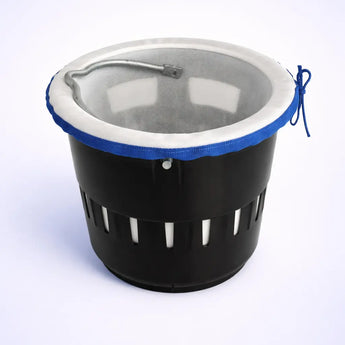
Form B1 is the one to reach for when depth is the constraint. At 250 mm it is the shallowest bucket in the range, and at Ø 305 mm the narrowest of the slotted forms.
That combination has a specific use: gully pots that were built shallow, or pots where an outlet, a trap or a benching detail leaves less clear depth than the nominal size suggests. A bucket that does not sit properly because it fouls something below is worse than no bucket at all, because it neither retains nor lets water through cleanly.
The single most common sizing error in this family is taking the gully pot’s catalogue size instead of measuring what is actually inside it.
Measure from the underside of the grating seating down to the point where the bucket would rest, and measure the clear internal diameter at the narrowest point of the shaft. Those two figures decide the form. If clear depth is under about 300 mm, B1 is usually the only form that fits.
At approximately 18 l the B1 holds less than the larger forms, and that is the trade. Less volume means the insert reaches its load sooner, which means a shorter check interval where the pellet load is high.
That is an acceptable trade when the alternative is a bucket that does not fit. It is not an acceptable trade when a deeper form would fit and simply was not measured for. Where you have the depth, D1 gives you more than twice the volume at a similar diameter.
| Feature | Value |
|---|---|
| Bucket | galvanised steel, slotted |
| Diameter | Ø 305 mm |
| Height | 250 mm |
| Volume | approx. 18 l, derived from external dimensions |
| Filter insert | textile, nominal 70 µm, pre-fitted |
| Replacement | insert only |
Regulatory context. EU Regulation 2025/2365 sets obligations for operators handling plastic pellets, and Operation Clean Sweep is a voluntary industry programme. A retention system can support the measures a site puts in place. It does not, on its own, make a site compliant with either, and WINKLER does not certify compliance. What a scheme achieves depends on the full set of measures, the maintenance regime and the documentation behind it. Background is set out in the guide.
Clear internal diameter around 305 mm and clear depth around 250 mm. If your pot is deeper, a taller form uses the space better.
A loaded insert restricts flow, and in a heavy event water will find the path of least resistance. We make no bypass claim in either direction: what the system does under surcharge depends on the pot, the inlet and the state of the insert. That is precisely why the check routine matters.
No. The insert is matched to the bucket. More volume means a different bucket form, not a longer insert.
These details are taken automatically from the technical table in the product description.
Selection guidance and technical background for choosing and using the product correctly.
Plastic pellet loss prevention ➔ where losses happen, which measures work and how EU 2025/2365 and OCS fit in. Read the guide!
Read guide →
Microplastics and tyre wear in stormwater ➔ what a micron rating tells you about retention and what it cannot. Read the guide!
Read guide →Your cart is currently empty.
Start Shopping


