
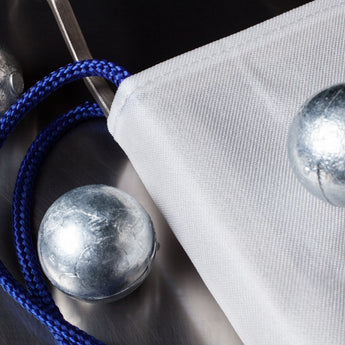


-
 non-stick refined
-
efficient
-
low maintenance

Graduated price (will be deducted from the shopping cart)
| dimension | individually | from 10 pieces |
|---|---|---|
| 160x80mm | €10.10 | €9.10 |
| 750x280mm | €24.10 | €21.70 |
| 830x230mm | €24.00 | €21.60 |
| 900x130mm | €21.70 | €19.50 |
| 1200x270mm | €33.60 | €30.20 |
| 1250x375mm | €39.10 | €35.30 |
Delivery time: 3 working days
Couldn't load pickup availability
Request an individual solution
Anode Bag for Organic-Rich Electrolytes – Plate-Tex Brillant for Nickel Electrolytes
Speciality Anode Bag for Stable Nickel Electrolytes and Superior Surface Finish
The WINKLER Anode Bag Plate-Tex Brillant was developed specifically for organic-rich electrolytes – particularly nickel electrolytes containing brighteners. In these baths, organic compounds and particles can quickly clog the filter fabric, leading to unstable processes.
Thanks to its special construction, the Plate-Tex Brillant delivers consistent filtration down to 25 µm while maintaining optimal ion flow in the electrolyte. The result: stable bath voltage, uniform coating thickness and high-quality surface finishes.
Typical Applications
The Plate-Tex Brillant was developed for plating processes where organic content puts particular strain on filtration:
- Nickel electrolytes with brighteners
- Electroplating processes with high organic content
- Surface finishing with demanding cosmetic requirements
- Industrial electroplating and series production
- Anode baskets, plate anodes and billet anodes
Specialised solutions are in demand for chemical surface treatment within the metal and electronics industry. This bag complements our range of premium anode bags and ensures stable deposition even with challenging electrolyte compositions.
Why Standard Anode Bags Fall Short With Organic-Rich Electrolytes
In electrolytes with a high proportion of organic additives, standard fabrics can clog quickly. The result is unstable bath voltage, uneven coating and higher maintenance effort.
The Plate-Tex Brillant was engineered specifically for these conditions. Its calendered non-stick surface significantly reduces build-up and enables consistently stable filtration.
Non-Stick Surface for Less Maintenance
A key feature of the Plate-Tex Brillant is its calendered inner surface. Thermal smoothing creates an especially even surface that organic residue struggles to cling to.
- Easy cleaning: Build-up is removed faster.
- Less maintenance time: Shorter cleaning intervals in operation.
- Stable filtration: Even permeability over long service periods.
- Consistent bath voltage: More stable electrochemical processes.
Material & Construction for Precise Electrolyte Filtration
The Plate-Tex Brillant is built on a high-quality polypropylene monofilament fabric. This fabric construction delivers precisely defined pore sizes and even filtration.
- Monofilament fabric: Consistent structure for reproducible filtration.
- Polypropylene (PP): Chemically resistant to a wide range of plating electrolytes.
- Calendered: Thermally smoothed surface with non-stick effect.
- High mechanical stability: Robust build for long service life.
Your Benefits for B2B Use
The Plate-Tex Brillant was developed for industrial applications where stable electrolytes are critical to product quality.
- Optimised for nickel electrolytes: Built for electrolytes with high organic content.
- Stable bath processes: Consistent filtration for reliable results.
- Reduced maintenance: Non-stick surface makes cleaning easier.
- Consistent filtration: 25 µm micron rating for secure sludge retention.
- Long service life: Robust filter fabric for industrial use.
- Custom sizing available: Made to fit anode baskets and anode shapes.
Which Variant Is Right for You? Comparing the Plate-Tex Anode Bags
Choosing the right anode bag depends on particle load and electrolyte type.
| Variant | Micron rating | Feature | Recommended for |
| Plate-Tex Classic | 15 µm | Standard anode bag | Cost-effective standard processes |
| Plate-Tex micro | 5 µm | Microfiltration | Precision processes |
| Plate-Tex Zwo | 15 µm | Double-layer filter | Mechanically demanding applications |
| Plate-Tex Brillant | 25 µm | Non-stick surface | Organic-rich electrolytes and nickel electrolytes |
Technical Data: Plate-Tex Brillant Anode Bag
| Material | Polypropylene (PP) |
| Fabric construction | Monofilament / monofilament |
| Fabric weight | 370 g/m² |
| Air permeability | 25 l·dm⁻²·min⁻¹ |
| Finish | calendered (thermally smoothed) |
| Base unit | Each |
| Micron rating | 25 µm* (*as stated by fabric supplier) |
Personal Advice for Your Electroplating Process
Electrolytes vary widely in composition and load. Our filtration experts can help you choose the optimal anode bag for organic-rich electrolytes – matched to bath chemistry, service life and process stability.
On request, we can manufacture the Plate-Tex Brillant to your exact anode basket or special anode dimensions.
FAQ – Anode Bag for High-Organic Electrolytes (PLATE-TEX Brillant)
Common Questions About the Anode Bag for Organic-Rich Nickel Electrolytes
The PLATE-TEX Brillant anode bag was developed specifically for plating electrolytes with a high organic content. Here you'll find answers to common questions about filtering nickel electrolytes, the non-stick surface, and choosing the right anode bag for stable bath processes.
When should a speciality anode bag for organic-rich electrolytes be used?
Why is the PLATE-TEX Brillant particularly suited to nickel electrolytes?
How does the calendered surface improve filtration in nickel electrolytes?
Why does a 25 µm micron rating make sense for organic-rich electrolytes?
Which plating applications suit this anode bag?


