


Guide
Preventing plastic pellet loss: measures, and how the frameworks fit together
Plastic pellet loss prevention ➔ where losses happen, which measures work and how EU 2025/2365 and OCS fit in. Read the guide!
Read guide →Starting price based on the lowest DHL weight tier (bis 6,99 kg). Final shipping costs depend on the total order weight and are calculated at checkout.
Couldn't load pickup availability
Need a custom size or a different version? Send us the key details directly via the form.
Pellet losses do not usually start at the site boundary. They start at a transfer point: a coupling, a big bag station, a hopper, a sweeping operation that pushes material towards the nearest drain. The drain closest to that point is where retention is worth having, and that drain is often a small yard gully rather than a road gully.
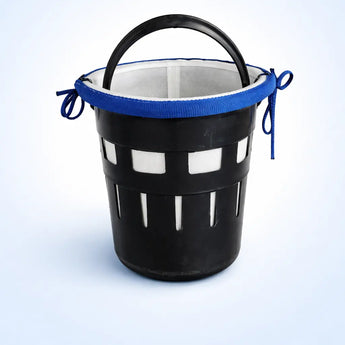
This is the smallest set in the family, at Ø 260 mm and 250 mm deep. It suits exactly that position: a point drain near the process, where the catchment is small, the material load is concentrated and access for checking is easy.
There is a temptation to fit the largest system available. On a point drainage near a transfer station that is usually the wrong instinct, for two reasons.
First, the geometry decides. A yard gully pot is small, and a 395 mm bucket will not go in. Fit is not negotiable.
Second, a small bucket near the source is checked more often, because it is in the way of people who walk past it. A retention system that gets looked at every week does more for pellet loss prevention than a large one at the site boundary that gets looked at every quarter.
The textile insert is designed around a nominal 70 µm. Standard plastic pellets are in the millimetre range and are held comfortably. Regrind and dust fractions vary far more: the coarse fraction is retained, the finest fraction is not.
The bucket collects, the textile filters, and the water leaves through the fabric. As the insert loads, the flow through it falls. That is why the system needs a check routine rather than a fit-and-forget approach, and why a system near the source is easier to run than one at a distance.
| Feature | Value |
|---|---|
| Bucket | galvanised steel |
| Diameter | Ø 260 mm |
| Height | 250 mm |
| Volume | approx. 13 l, derived from external dimensions |
| Filter insert | textile, nominal 70 µm, pre-fitted |
| Replacement | insert only |
Regulatory context. EU Regulation 2025/2365 sets obligations for operators handling plastic pellets, and Operation Clean Sweep is a voluntary industry programme. A retention system can support the measures a site puts in place. It does not, on its own, make a site compliant with either, and WINKLER does not certify compliance. What a scheme achieves depends on the full set of measures, the maintenance regime and the documentation behind it. Background is set out in the guide.
Measure the clear internal diameter and depth of the gully pot. This set needs a pot that takes Ø 260 mm and 250 mm of depth. If yours is larger, one of the slotted bucket forms will suit better.
There is no fixed interval. Near a transfer point the load can arrive in a single incident rather than gradually. A weekly visual check is a workable starting routine, tightened where the drain is close to a known loss point.
That is a question for the site’s loss assessment rather than a product question. The usual approach is to identify the drains downstream of handling areas and start there.
The bucket is galvanised, which is the standard specification for this application. Where there is de-icing salt or an aggressive process medium, tell us before ordering.
These details are taken automatically from the technical table in the product description.
Selection guidance and technical background for choosing and using the product correctly.
Plastic pellet loss prevention ➔ where losses happen, which measures work and how EU 2025/2365 and OCS fit in. Read the guide!
Read guide →
Microplastics and tyre wear in stormwater ➔ what a micron rating tells you about retention and what it cannot. Read the guide!
Read guide →Your cart is currently empty.
Start Shopping


