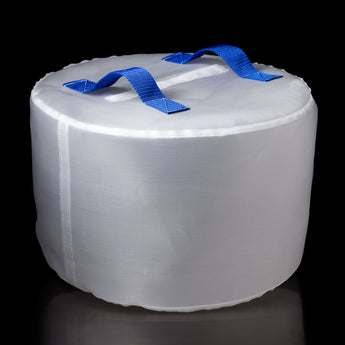
Ion Exchange Resin Bag for Industrial Water Treatment
A refillable, empty ion exchange resin bag, not a filled DI cartridge
This is the textile bag. It arrives empty, and you fill it with your own resin.
That needs saying at the top, because in English most searches around this product expect something else. A DI resin bag, a mixed bed resin bag or a water softener resin bag usually means a bag that already contains the medium, or a ready-made cartridge. We do not supply resin, regenerants, vessels or complete plant. We supply the part that keeps the resin where it is meant to be.
In an ion exchange stage the resin has to stay in the vessel and still be flowed through. This water treatment resin bag does both: it takes up the ion exchange resin, holds it in place and lets the water pass.
What happens afterwards is the resin’s work. Softening, demineralisation, capacity and the achievable water quality depend on the resin chosen, its loading, the regeneration and the way the plant is run. The bag is a container for the medium, not a process step.
The hook-and-loop closure is the actual design decision on this resin containment bag
A resin change is not a one-off event. The bag is opened, emptied, refilled and closed again, and that repeats over the whole service life.
This version therefore has an overlapping sewn-on hook-and-loop closure. Overlapping means the two panels close across an area rather than meeting edge to edge. That is the difference between a closure that keeps a gap open when the bag is full and one that actually covers the opening. It is also why a resin bag with hook and loop closure is the right choice here and the wrong one on the other two products in this category, which are filled once and then fitted.
Retention of the resin does not hang on the closure alone. Swollen grain size, fill level, the condition of the seams, damage and the flow conditions all play a part. That is why we describe this as a resin containment bag for water treatment rather than as a guarantee, and why we do not promise that resin carry-over is ruled out. What we can say is which of those factors you can influence, and the guide on resin changes goes through them.
What the 100 micron ion exchange resin bag figure actually means
The 100 µm filter fineness is the fabric supplier’s figure for the flat material. It describes how the fabric is specified, not a tested retention limit for the filled bag.
A size comparison helps to place it. Commercial ion exchange resins sit in the range of a few tenths of a millimetre, so several times above 100 µm. The figure is therefore comfortably below the grain size of intact resin. What moves below that line is mainly fines, broken beads and attrition, and that fraction grows with operating time and with every regeneration cycle.
For selection that means the 100 µm is a useful reference point, but the figure to work from is the swollen grain size of your resin. Send us the resin type and the data sheet value and we will place it.
Why 800 l·dm⁻²·min⁻¹ is not a water throughput
An air permeability of 800 l·dm⁻²·min⁻¹ is documented for this fabric. For scale: the anode bags for electroplating sit between 25 and 125 on the same measurement, so this fabric is an open one by the standards of the range.
The value comes from the special satin weave. In a satin weave the weft yarn passes over several warp yarns, which produces a smooth surface with a comparatively open structure. Calendering then smooths the fabric under pressure.
The value is measured on dry air against flat material. In service, water flows through a bag filled with resin, and the flow resistance then arises mainly at the resin bed rather than at the fabric. A high air value is a good sign for the material selection. It does not predict the volume flow your plant will reach, and any figure that claims it does should be treated with suspicion.
The 25 litres and the three standard sizes
The product description carries this bag at 25 litres. That figure belongs to the main description and does not transfer to all three sizes, because the standard dimensions differ considerably.
| Standard size | Calculated cylinder volume from the dimensions |
|---|
| Ø 300 × 250 mm | around 17.7 l |
| Ø 350 × 250 mm | around 24.1 l |
| Ø 400 × 230 mm | around 28.9 l |
Between the smallest and the largest version that is a difference of roughly 40 per cent. The figures in the right-hand column are calculated from the dimensions and describe the geometric envelope, not the practical fill quantity; how much resin actually goes in depends on the fill level and on how much room is left for closing.
For selection the volume alone is not the deciding factor anyway. The internal diameter of your vessel and the available height are. Note that the largest version at 230 mm is also the shortest, so choosing by height does not automatically lead to the largest size. A 25 litre ion exchange resin bag in the strict sense is the middle one.
Enquiries reach us in both spellings, as a 25 liter ion exchange resin bag and as a 25 litre one, and occasionally as an ion exchanger resin bag. They all mean this product. The figure is what needs pinning down, not the wording.
Material and weave of the polypropylene resin filter bag
The material is polypropylene in a special satin weave at 250 g/m², calendered.
Polypropylene is resistant to many aqueous media and is an established material in industrial water treatment. Whether it suits your particular process water depends on composition, concentration, temperature and operating regime. We do not give a blanket resistance assurance.
Calendering smooths the surface under pressure, which makes the fabric more closed and the surface more even.
Resin type matters, including mixed bed
Ion exchange resins differ in grain size, swelling behaviour and mechanical stability. Two things matter most for choosing the bag: the swollen grain size and the fines fraction to be expected.
Whether this bag suits a mixed bed resin is therefore something we clarify case by case. Mixed bed resins combine cation and anion exchangers in one bed, and the two components can bring different grain sizes and different swelling behaviour with them. We deliberately do not list a mixed bed bag as a standard item while those figures are unknown. The same applies to a resin bag for an ion exchange column: we supply the bag that goes into the column, not the column.
A resin retention bag for water treatment that can be used more than once
The polypropylene version is intended for repeated use. After emptying, the bag can be refilled.
A cleaning procedure is not part of the product data, because the right method depends on the resin, the process water and the loading. Before each refill, seams, hook-and-loop surface and fabric should be checked. A bag with a damaged seam or a worn closure holds no resin back, however good the fabric is.
Technical data of the ion exchange resin bag
| Feature | Value |
|---|
| Supplied | empty, ion exchange resin not included |
| Material | polypropylene |
| Fabric construction | special satin weave |
| Finish | calendered |
| Fabric weight | 250 g/m², fabric supplier’s figure |
| Air permeability | 800 l·dm⁻²·min⁻¹, fabric supplier’s figure |
| Filter fineness | 100 µm, fabric supplier’s figure |
| Closure | overlapping sewn-on hook-and-loop closure |
| Standard sizes | Ø 300 × 250, Ø 350 × 250 and Ø 400 × 230 mm |
| Reuse | intended |
| Base unit | each |
| Custom sizes | available |
Frequently asked questions about the filter bag for ion exchange resin
The questions come from water treatment and concern resin retention, flow, size and reuse.
Is ion exchange resin included?
No. The industrial ion exchange resin bag is supplied empty. Resin, vessels and complete treatment systems are not part of the scope of supply.
Is this a filled DI or mixed bed resin bag?
No. Searches for a DI resin bag, a demineralisation resin bag or a mixed bed resin bag usually lead to filled products or cartridges. This is the empty textile bag that you fill with your own resin.
Will the resin stay in the bag?
The overlapping hook-and-loop closure and the 100 µm fabric are designed to retain the resin. We do not guarantee that resin carry-over is ruled out, because grain size, swelling, fill level, seam condition and flow all contribute.
What does the 100 µm figure mean?
It is the fabric supplier’s figure for the flat material. Common ion exchange resins are several times larger in grain size. Below that line you mainly find broken beads and attrition, and that fraction increases with operating time.
Will the bag restrict the flow in my plant?
The documented air permeability of 800 l·dm⁻²·min⁻¹ is measured on dry air against flat fabric. In service the resistance arises mainly at the resin bed. No conclusion about your plant’s volume flow can be drawn from the air value.
Does the 25 litre figure apply to all standard sizes?
No. The three standard sizes differ by roughly 40 per cent in calculated volume. Choose the size by the internal diameter and the available height of your vessel rather than by the litre figure.
Can the bag be used more than once?
Yes, the PP version is intended for repeated use. Check seams, hook-and-loop surface and fabric before each refill. We do not prescribe a general cleaning procedure, because it depends on the resin and the process water.
What is the difference from the high purity version?
This version is PP fabric with a hook-and-loop closure for repeated resin changes. The high purity version is PE nonwoven with a PTFE sewing thread and is intended for purity-sensitive chemical processes.
Do you make custom sizes for existing vessels?
Yes. For that we need the internal dimensions of the vessel, the installation orientation, resin type with grain size, required fill quantity, closure type and quantity. A drawing or a sample helps.