


Guide
Preventing plastic pellet loss: measures, and how the frameworks fit together
Plastic pellet loss prevention ➔ where losses happen, which measures work and how EU 2025/2365 and OCS fit in. Read the guide!
Read guide →Starting price based on the lowest DHL weight tier (bis 6,99 kg). Final shipping costs depend on the total order weight and are calculated at checkout.
Couldn't load pickup availability
Need a custom size or a different version? Send us the key details directly via the form.
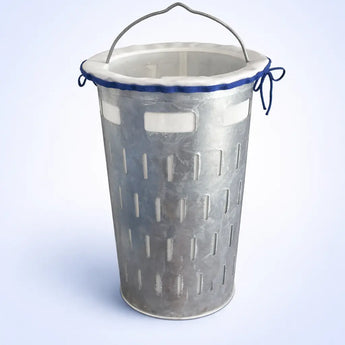
At 600 mm the A4 is the tallest bucket in the range. It belongs in deep road gullies, the kind used on trafficked surfaces where the pot was sized for sediment rather than for convenience.
Depth is an advantage in two ways here. The obvious one is volume. The less obvious one matters more on a road: a deep bucket puts more distance between the retained material and the grating, so what has been collected is less likely to be disturbed by the next heavy inflow.
A road gully on a trafficked surface collects far more than pellets. Grit, sand, road sweepings and organic material arrive with every event, and on an industrial site with vehicle movements they arrive continuously.
That mixed load fills a bucket faster than pellets alone would, and it loads the textile insert faster too. On a road gully the A4’s volume is not luxury, it is what makes a sensible service interval possible. Fitting a shallow form in a position like this produces a system that needs emptying so often that it stops being maintained.
This is the comparison that catches people out. A4 and C3 both hold around 70 l. On paper they are interchangeable.
| A4 | C3 | |
|---|---|---|
| Diameter | Ø 385 mm | Ø 395 mm |
| Height | 600 mm | 575 mm |
| Volume | approx. 70 l | approx. 70 l |
| Decisive when | the pot is narrow and deep | the pot is wide and deep |
The 10 mm of diameter and 25 mm of height are what decide it, because they decide whether the bucket goes in. Choosing between these two is a fitting question and never a capacity question.
| Feature | Value |
|---|---|
| Bucket | galvanised steel, slotted |
| Diameter | Ø 385 mm |
| Height | 600 mm |
| Volume | approx. 70 l, derived from external dimensions |
| Filter insert | textile, nominal 70 µm, pre-fitted |
| Replacement | insert only |
Regulatory context. EU Regulation 2025/2365 sets obligations for operators handling plastic pellets, and Operation Clean Sweep is a voluntary industry programme. A retention system can support the measures a site puts in place. It does not, on its own, make a site compliant with either, and WINKLER does not certify compliance. What a scheme achieves depends on the full set of measures, the maintenance regime and the documentation behind it. Background is set out in the guide.
Only if the pot has it. A bucket that fouls the outlet or sits proud of the seating is not usable. Measure the clear depth first.
Full of wet sediment it is heavy enough that lifting it out by hand is not the plan. Factor extraction into the position: a gully that needs a lifting aid is fine if that is known in advance and awkward if it is discovered on the day.
Not necessarily. Emptying and insert replacement are two decisions. If the textile is intact and still passing water, it goes back in.
These details are taken automatically from the technical table in the product description.
Selection guidance and technical background for choosing and using the product correctly.
Plastic pellet loss prevention ➔ where losses happen, which measures work and how EU 2025/2365 and OCS fit in. Read the guide!
Read guide →
Microplastics and tyre wear in stormwater ➔ what a micron rating tells you about retention and what it cannot. Read the guide!
Read guide →Your cart is currently empty.
Start Shopping


