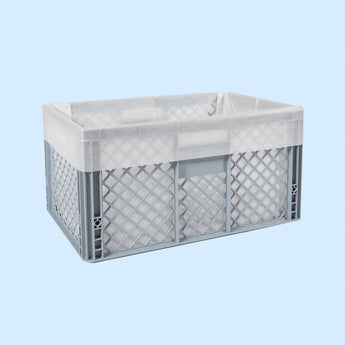
Paint sludge dewatering box for paint and coating residues
The dewatering box and the filter bag do two different jobs
The dewatering box is a sturdy polypropylene container. It takes a nonwoven filter bag, holds it in shape, carries the weight of the sludge and lets the water that comes out drain away. What it does not do is filter. Solid and liquid are separated entirely by the nonwoven insert.
Depending on the operation, the same design is called a paint sludge filter box or a paint sludge filtration box. In every case it means an open container with a filtrate outlet, into which a nonwoven bag is placed. Separating the two jobs sounds obvious, and it still causes regular misunderstandings at the ordering stage. So it belongs at the top: the filter bag is not included. You buy the box once and the bags as a consumable in packs of 25.
Dimensions of the dewatering box and what follows from them
| Dimensions |
|---|
| External, L × W × H | 60 × 40 × 32 cm |
| Internal, L × W × H | 57 × 37 × 30.5 cm |
The external dimension of 60 by 40 centimetres is half a Euro pallet footprint. The box therefore fits standard shelving, trolleys and transport frames without overhanging. The internal dimension of 57 by 37 centimetres at 30.5 centimetres deep determines how much sludge one batch can take and which bag size will go in.
When siting the box, place it so that the filtrate drains away under control and is collected. What happens to that filtrate depends on the paints in use and on your own operating requirements. It is not automatically suitable for discharge.
Dewatering box filter bags: the two nonwoven inserts
Two nonwoven filter bags are available for the box. Both are made from thermally bonded polypropylene spunbond nonwoven with a hydrophilic finish and are supplied in packs of 25.
| Bag | Basis weight | Air permeability | Suits |
|---|
| Color Drain | 15 g/m², 0.16 mm | 8,900 l/m²/s | stable flocs, where the water should leave quickly |
| Nonwoven 30 g/m² | 30 g/m², 0.25 mm | 4,300 l/m²/s | finer fractions and mechanical load |
Switching between the two needs no change to the box. If you are unsure, start with the 30 g/m² nonwoven and move to Color Drain if drainage is too slow.
Where the box is used in paint shops and coagulation systems
The box stands where paint and coating residues arise and the sludge is not to be disposed of as a liquid. That means decorating firms and paint shops with a fixed tool cleaning station, surface treatment operations with coagulation systems where the flocculated sludge is drawn off, and workshops where cleaning guns, rollers and containers produces sludge water on a regular basis.
The box is also used outside paint work, for instance to catch drilling and grinding water at a fixed workstation. What matters is that the material suits the bag: for abrasive mineral sludges in any quantity, the 200 g/m² geotextile bags are the right product group.
Technical data, dewatering box
| Feature | Value |
|---|
| Material | Polypropylene |
| External dimensions L × W × H | 60 × 40 × 32 cm |
| Internal dimensions L × W × H | 57 × 37 × 30.5 cm |
| Scope of supply | box without filter bags |
| Matching inserts | Color Drain 15 g/m², nonwoven 30 g/m², packs of 25 |
| Use | reusable |
| Delivery time | 1 to 2 working days |
Questions we are asked about the box and the filter bags
The point that needs clearing up most often is the scope of supply, followed by which bag belongs in the box.
Is a filter bag included?
No. The box is supplied without bags. For a first order we suggest one pack of 25 so that you can compare both versions in your own process.
How much paint sludge fits into one batch?
The internal volume works out at around 64 litres. In practice the box is not filled to the top edge, because water stands above the sludge during filling. The usable quantity per batch depends on solids content and is well below that figure in most operations.
Can I clean the box and use it again?
Yes. The box is the permanent element in the system and the bag is the consumable. Polypropylene can be cleaned with the products normally found in a paint shop.
Will the dewatering box fit under my coagulation system?
At 32 centimetres tall on a 60 by 40 centimetre footprint it fits under many systems. The binding check is against your own draw-off point and clear height. Tell us the type of system and the dimensions and we will look at it.
What if the box is too small?
For larger quantities, either a second box is the simplest answer or you move to a free-standing sludge dewatering bag. Which of the two is more economical depends on batch quantity and available space.