


i
Starting price based on the lowest DHL weight tier (bis 6,99 kg). Final shipping costs depend on the total order weight and are calculated at checkout.
Couldn't load pickup availability
Request a custom solution
Need a custom size or a different version? Send us the key details directly via the form.
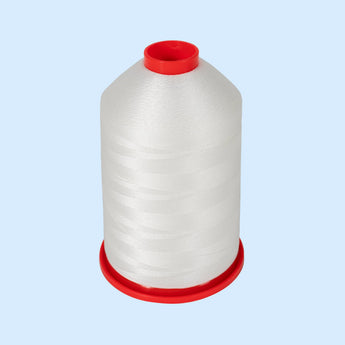
High-Tenacity Polypropylene Industrial Sewing Thread for Technical Textiles
Why technical textiles need a different thread
A filter bag, a filter cloth or a technical cover is loaded differently from a garment. It sees tensile forces across the whole surface, repeated load cycles, process media and often temperature. A household thread does not survive that, and it fails where it hurts most: in the seam.
This industrial sewing thread is built for the job. It is made from high-tenacity polypropylene, constructed as Nm 40x3, and the data sheet gives a breaking force of approximately 45.20 N.
Nm 40x3 means three single ends of metric count 40 twisted together. The load is shared across three ends, and the twist also makes the thread smoother, so it runs more cleanly through the needle eye and the thread guides.
A high-tenacity sewing thread does not get there by twist alone. Fibre form counts too. A continuous filament sewing thread runs unbroken filaments along the whole length of the yarn and reaches higher values than a thread spun from short staple fibres. This one is designed as a technical sewing thread for industrial use and for technical textiles, not for garments.
What 45.20 N tells you and what it does not
This is where the biggest misunderstanding about a strong sewing thread sits.
The 45.20 N is the force at which a single thread parts in a test rig. The strength of your seam is a different thing entirely. It comes out of several factors working together:
| Factor | Effect on the seam |
|---|---|
| Base material | A fabric can tear at the needle hole before the thread gives |
| Stitch type and stitch length | Determine how many stitches take up a given force |
| Needle size | Oversized needles perforate the material and weaken it |
| Thread tension | A seam sewn too tight is the first thing to go under load |
| Edge distance | Sew too close to the edge and the seam pulls out |
| Seam construction | Single, double, bound or covered |
So we do not promise that a seam made with this thread will be tight or permanently load-bearing. What we can promise is a thread with documented values, designed for technical sewing work.
For series production, or for thermally, chemically or mechanically demanding conditions, a sample seam under realistic conditions is the only reliable answer.
A word on the market term. Heavy duty thread and heavy duty sewing thread are searched mainly for upholstery, leather and household work, and neither phrase carries a figure. This is a heavy duty sewing thread only in the sense that it is built as Nm 40x3 with a breaking force of approximately 45.20 N. Compare the number, not the label.
How to choose an industrial sewing thread
Four questions settle it, in this order.
What is the base material? Polypropylene thread pairs best with a polypropylene base material, because both behave in a comparable way under temperature and process media. For other base materials it is worth a quick call before ordering.
What does the seam have to do? A closure seam, a load-carrying edge seam and a repair on an existing seam make different demands. The heavier the duty, the more the seam construction matters and the less the thread figure alone tells you.
Which needle does the machine take? Nm 90 to 120 is the recommended range. The span is deliberately wide because it depends on the base material. Needles too small create too much friction: the thread heats up, frays and breaks while sewing. Needles too large punch a hole bigger than the thread that fills it, which on dense filter fabrics creates a weak point at every stitch.
What is the process exposure? Medium, concentration, temperature and contact time decide whether polypropylene is the right material at all. A heat test value of 120 °C over two minutes with residual shrinkage of approximately ±1.5 % exists for this thread. That is a test value and not a continuous service temperature.
Elongation at break is 25 to 35 %. A thread with that much give yields slightly under load instead of parting immediately, which is an advantage in seams that work in service.
Sewing thread for filter bags, filter cloths and filter socks
The core of this product is in filtration, and it is needed in two situations.
In manufacturing. Converters sew bags, cloths, socks and covers from roll goods. Here the thread has a say in how the finished assembly holds together.
In repair. A seam that has opened, a pulled-out eyelet, a damaged edge. Whether it can be repaired depends on the damage: an opened seam can often be resewn, while a fabric that is weakened across an area or chemically attacked cannot be saved with a seam.
A filter bag repair thread does not replace an assessment of condition. Before anything is sewn, the question is whether the base material will carry the repair at all.
Where the closure cord rather than the fabric is the problem, a braided cord is the answer instead.
Thread materials for technical textiles
Three yarn materials are common in industrial converting. The comparison is here to help you decide whether the thread on this page fits your case.
| Material | Typical profile |
|---|---|
| Polypropylene | Good chemical resistance in aqueous media, low density, limited temperature resistance |
| Polyester | Higher temperature and UV resistance, more sensitive to strong alkalis |
| PTFE | Chemically very unreactive and temperature resistant, considerably more expensive |
What is offered on this page is the polypropylene thread. An industrial polyester thread and a PTFE sewing thread are separate product groups with their own data sheets; whether we can source them for your case is something we clarify on request.
That comparison is deliberately kept general. Polyester and PTFE threads are not standard items in this shop, and their values cannot be derived from the polypropylene data sheet.
Technical data
| Feature | Value |
|---|---|
| Material | high-tenacity polypropylene |
| Thread construction | Nm 40x3 |
| Breaking force | approx. 45.20 N, yarn manufacturer’s figure |
| Elongation at break | 25 to 35 % |
| Recommended needle | Nm 90 to 120 |
| Heat test value | 120 °C over 2 minutes, residual shrinkage approx. ±1.5 %, not a continuous service value |
| Sales unit | 1 cone |
| Run length | to be added from the item master before publication |
Frequently asked questions about the industrial sewing thread
Which technical textiles is the thread suitable for?
For suitable technical fabrics and nonwovens, particularly in polypropylene. Whether thread and base material go together depends on material, process medium and temperature.
Which needle size is recommended?
Nm 90 to 120, depending on the base material. Needles too small make the thread fray, needles too large weaken the fabric at every stitch.
What does the breaking force of 45.20 N mean?
It describes a single thread in a test rig. The strength of the finished seam follows from base material, stitch type, stitch length, needle, thread tension, edge distance and seam construction.
Can every damaged filter be repaired?
No. An opened seam can often be resewn. A fabric weakened across an area or chemically attacked cannot. The condition of the base material has to be assessed before the repair.
Is the thread chemically and UV resistant?
Polypropylene stands up to many media in aqueous conditions. We do not give a blanket chemical or UV release for this thread; medium, concentration, temperature and contact time decide.
What temperature can the thread be used at?
The value available comes from a heat test at 120 °C over two minutes and is not a continuous service temperature. For operation at elevated temperature we look at the conditions case by case.
Do you supply polyester or PTFE sewing thread?
The thread offered on this page is polypropylene. Other yarn materials are separate product groups; talk to us if your process needs them.
What sales unit is supplied?
One cone. Cones are the usual presentation in industrial converting because the thread feeds straight into the machine without rewinding. The run length is in the technical table.
Are you the manufacturer or the supplier of the thread?
We do not spin the yarn. As an industrial sewing thread supplier we source it from a specialist manufacturer and select it for the application. If you are looking for an industrial sewing thread manufacturer with its own spinning mill, we are the wrong address. If you are looking for a thread that suits your filter textile, we are the right one.
Can I order the industrial sewing thread directly?
Yes. The polypropylene version is a standard item and can be ordered straight from this page. If you are unsure about the base material, that is worth clearing up first.
Technical data
These details are taken automatically from the technical table in the product description.


