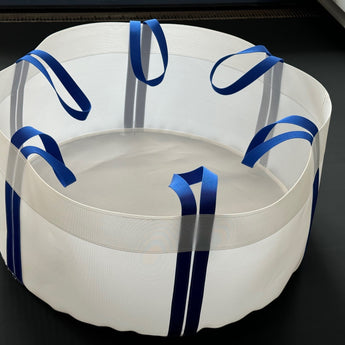
Rainwater tank inlet filter bag for DN325 to DN800
The filter sits where the water arrives
This is an in-tank rainwater filter. The bag hangs inside the tank, directly beneath the inlet, so that everything arriving with the water runs into it. Six straps around the top edge hold it at the existing opening, and an 80 mm reinforced hem keeps that edge in shape once the bag carries weight.
The position matters more than any other property here, because it decides what the product can and cannot do. Water arrives, passes through the polyester composite, and the solids stay in the bag. Leaves, grit, roof debris, moss and the fine sediment that would otherwise settle on the tank floor are held where you can reach them, rather than in a place that needs emptying with a pump.
What a rainwater sediment filter changes in the tank
The sediment that reaches a rainwater tank does not leave again on its own. It settles, builds a layer on the floor and gets stirred up whenever the tank is drawn down quickly. From there it travels into pumps, filters, drip lines and everything downstream.
A rainwater debris filter at the inlet moves that problem forward to a point where it costs a bag change instead of a tank clean. That is the whole economic argument for this product, and it holds whether the tank feeds a garden, a washing line or a process.
What it does not do is make rainwater drinkable. This is a particle filter. It removes solids above its retention range and nothing else: no dissolved substances, no bacteria, no colour. Anyone looking for potable water needs a treatment train, not a filter bag.
Six sizes from DN325 to DN800
The bag is available in six nominal sizes from DN325 to DN800. The figure refers to the tank opening the bag is fitted to, so measuring is straightforward: the clear internal diameter of the inlet opening, measured at the widest point.
That single measurement is what most enquiries turn on. If your opening sits between two sizes, or if it is oval rather than round, we make the bag to your dimensions. The guide on retrofitting explains which measurements to take and what to do about an inlet that is hard to reach.
Washable and reusable, within limits
Unlike most filter bags in this shop, this one is not a consumable. It can be rinsed out and refitted, which is the reason it suits tanks that are checked seasonally rather than weekly.
The limit is condition, not time. As long as material, seams and straps are undamaged, the bag goes back in. Once the fabric is worn, a seam has opened or a strap has torn, it is replaced. We do not publish a service life in months, because the load on a tank inlet depends entirely on the roof area connected to it, the surroundings and the season. A tank under a birch tree in autumn sees more in six weeks than a tank on an open roof sees in a year.
Nominal 70 µm: what the figure describes
A nominal filtration rating of approximately 70 µm is documented for the polyester composite. Nominal describes how the material is designed, not a measured cut-off. What is actually retained depends on particle shape, on how loaded the bag already is and on how much water arrives at once.
There is a trade-off worth knowing before you order. A finer filter is not automatically the better one. The finer the material, the sooner it loads, and a loaded bag at a tank inlet can hold water back rather than let it through. For most rainwater harvesting installations, 70 µm at the inlet is the sensible balance between what you keep out and how often you have to service it.
Technical data, rainwater tank inlet filter bag
| Feature | Value |
|---|
| Material | Polyester composite |
| Filtration rating | nominal approx. 70 µm |
| Sizes | DN325, DN400, DN500, DN600, DN700, DN800 |
| Straps | six, 25 mm wide, running around the bag |
| Top edge | 80 mm reinforced hem |
| Position | inside the tank, below the inlet |
| Use | washable and reusable |
| Custom sizes | to your measurements |
How this differs from the other rainwater filters on the market
Search for a pre tank rainwater filter and you will find several designs that do different jobs. The differences matter, because they sit at different points in the system.
| Design | Position | What it does |
|---|
| Downpipe leaf separator | in the downpipe | takes coarse leaves before the water reaches the tank |
| Vortex or self-cleaning filter | before the tank inlet | separates a fraction of the flow and flushes debris to drain |
| Rigid filter basket | in the tank opening | catches coarse material, fixed geometry |
| This filter bag | in the tank, below the inlet | holds fine solids across a large textile area, retrofittable |
As a rainwater harvesting filter bag for tank inlets, this is the option that suits an existing tank, because it needs no pipework change and no fixed housing. Where a tank is being built new, a combination is often sensible: coarse separation in the downpipe, fine retention in the tank. The comparison is set out in full on the application page.
Questions about the cistern inlet filter bag
Which size do I need?
Measure the clear internal diameter of the tank inlet opening at its widest point. That figure gives you the DN size. If it falls between two standard sizes, send us the measurement.
Does the bag work in a tank that is already installed?
Yes, and that is what it is designed for. The bag hangs from the existing opening and needs no modification to pipework or lid. What it does need is access: you have to be able to reach the opening to fit and remove it.
How often does it need cleaning?
There is no general interval. It depends on the connected roof area, on trees and on the season. A practical routine is to check after the first heavy rain of autumn and again in spring. If water starts backing up at the inlet, the bag is loaded.
Can I use rainwater filtered this way as drinking water?
No. This is a particle filter for a rainwater harvesting system. It removes solids and does not treat water. Drinking water requires a different approach entirely.
What happens if the bag blocks?
Water will back up at the inlet rather than pass through. That is why the servicing interval matters more than the fineness. If your inlet loads quickly, a coarse separator upstream will take pressure off the bag.
Is the fabric affected by frost or UV?
Inside a tank the bag sits in the dark and stays wet, which is the least demanding condition for the material. We do not make blanket statements about UV or chemical resistance; if your water carries something unusual, tell us what it is.