


Guide
Choosing coolant filter media: paper, gsm and roll dimensions
Filter paper or nonwoven? What gsm does not tell you about microns ➔ plus the five dimensions to measure on your belt filter. Read the...
Read guide →Starting price based on the lowest DHL weight tier (bis 6,99 kg). Final shipping costs depend on the total order weight and are calculated at checkout.
Couldn't load pickup availability
Need a custom size or a different version? Send us the key details directly via the form.
This page is written for one particular moment. You are already running a 30 gsm viscose media, and there are more fines in the filtrate or in the tank than you would like. Or the solids load has gone up because the workpiece material, the cutting data or the utilisation of the machine has changed.
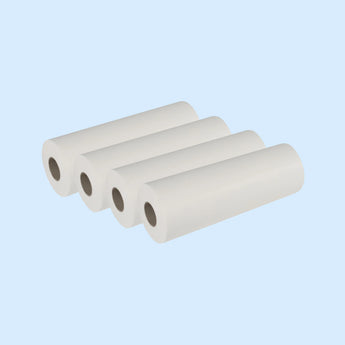
A 50 gsm viscose filter roll is the obvious next step for that case. It is the same raw material and the same bonding as the V30, built more densely. You are not changing the material, only the grade, and on a running machine that is the lower-risk change.
Because both qualities were tested to the same standard at 2 millibar, their figures are the only two in this product family that can be compared directly.
| V30 | V50 | Difference | |
|---|---|---|---|
| Fabric weight | 30 gsm | 50 gsm | plus 67 % |
| Thickness | 0.25 mm | 0.36 mm | plus 44 % |
| Air permeability at 2 mbar | approx. 5,300 l/m²/s | approx. 3,600 l/m²/s | minus 32 % |
| Maximum tensile force, MD | 80 N/5 cm | 125 N/5 cm | plus 56 % |
| Maximum tensile force, CD | 13 N/5 cm | 25 N/5 cm | plus 92 % |
Three of those rows matter in practice. The thickness says there is more fibre material in the cross section. The lower air permeability says the material offers more resistance to flow. And the much higher cross-direction tensile force says the media takes more mechanical load as the belt pulls it forward, which is a real argument under a heavy filter cake.
A denser media tends to hold back more. That is plausible, and it is the reason this quality exists alongside the V30.
What does not follow is a particular cut-off. There is no tested filtration rating for the V50, and none can be derived from 50 gsm. Nor is a longer roll life predictable: a denser media takes up more, but also closes faster. Which of the two effects wins in your machine depends on the solids load, the belt control and the differential pressure threshold.
That is why moving from V30 to V50 is always worth measuring. A trial roll over a full maintenance cycle gives the answer no data sheet can.
Two cases argue against this quality.
If flow is already tight and the machine indexes frequently, a denser media makes that worse. The cause then lies in the sizing of the filter area or in pre-separation rather than in the fabric weight.
And for grinding processes with very fine sludge the V50 is usually not the right answer either. That is the job of the much thicker polyester media P150, which at 1.31 millimetres is around four times as thick and is built differently.
| Feature | Value |
|---|---|
| Material | viscose |
| Bonding | chemically bonded |
| Fabric weight | 50 gsm |
| Thickness | 0.36 mm |
| Maximum tensile force, MD/CD | 125/25 N/5 cm |
| Elongation at maximum force | 8/20 % |
| Air permeability | approx. 3,600 l/m²/s at 2 mbar to DIN EN 9237 |
| Standard widths | 500 mm, 710 mm, 1.000 mm |
| Roll length | 100 m |
| Pack quantity | 500 mm four rolls, 710 mm three rolls, 1.000 mm two rolls |
The core diameter is not documented for this quality. If your machine requires a particular core, send us the dimension. The three widths are the same across the category: a 500mm coolant filter roll, a 710mm coolant filter roll and a 1000mm coolant filter roll.
Almost every question about this quality is a comparison with the V30.
Same raw material and same bonding, but 50 instead of 30 gsm, 0.36 instead of 0.25 mm thickness and around 3,600 instead of 5,300 l/m²/s air permeability under the same test condition, plus a noticeably higher tensile strength.
It is built more densely and passes less, which suggests higher retention. There is no tested filtration rating for either quality, and none can be derived from the fabric weight. The statement only becomes reliable through a trial in your machine.
That cannot be answered in general. More material can take up more, but a denser media also closes faster. Which effect wins is decided by your solids load and your belt control.
The trade calls it a viscose paper filter roll, and it runs on the same belt filters as paper media. The material is a viscose nonwoven, not cellulose paper.
Whenever you want to move up from the V30, or when the workpiece material, the cutting data or the utilisation has changed. One roll over a full maintenance cycle shows roll life, filtrate quality and indexing behaviour under real conditions.
For grinding with very fine sludge the polyester media P150 is usually the better fit. It is around four times as thick at 1.31 mm and bonded differently.
Roll width, running length, core diameter, the maximum roll outside diameter in the magazine and the unwind direction. The guide takes you through the measurement.
These details are taken automatically from the technical table in the product description.
Overview of all variants stored in the shop. Ordering still takes place through the variant selector above.
| Size | Price | Availability |
|---|---|---|
| 500mm (4 rolls) | 53,52 € gross / roll 44,97 € net / roll Sales unit: 4 rolls = 214,08 € gross | 179,90 € net | Available |
| 710mm (3 wheels) | 72,59 € gross / roll 61,00 € net / roll Sales unit: 3 rolls = 217,77 € gross | 183,00 € net | Available |
| 1000mm (2 rolls) | 107,04 € gross / roll 89,95 € net / roll Sales unit: 2 rolls = 214,08 € gross | 179,90 € net | Available |
Selection guidance and technical background for choosing and using the product correctly.
Filter paper or nonwoven? What gsm does not tell you about microns ➔ plus the five dimensions to measure on your belt filter. Read the...
Read guide →Your cart is currently empty.
Start Shopping


