


Guide
Choosing coolant filter media: paper, gsm and roll dimensions
Filter paper or nonwoven? What gsm does not tell you about microns ➔ plus the five dimensions to measure on your belt filter. Read the...
Read guide →Starting price based on the lowest DHL weight tier (bis 6,99 kg). Final shipping costs depend on the total order weight and are calculated at checkout.
Couldn't load pickup availability
Need a custom size or a different version? Send us the key details directly via the form.
Turning, milling and drilling wash swarf, fines and dust out of the cutting zone with the coolant. A belt filter draws the media slowly across the filter area, holds the solids back and returns the cleaned fluid to the tank. Once enough material has built up and flow drops, the machine indexes the media forward.
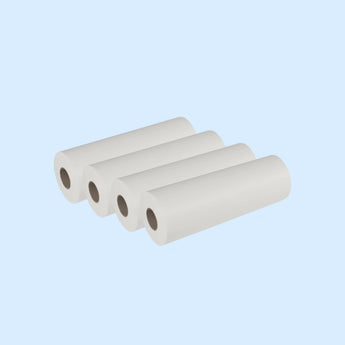
The V30 is where most operations start in that process. It is the lighter of our two viscose qualities and, in this category, the quality we ship most of. If you are buying a coolant filter roll without knowing your machine in detail, this is usually the right first choice.
It is also the product behind the term this shop already ranks for. A filter fleece roll for coolant and a viscose paper filter roll are, in this context, the same thing: a nonwoven media roll for a belt filter system. See the section on names below if that sounds contradictory.
The designation is systematic, and it is asked about often enough to be worth a sentence.
The letter is the raw material: V for viscose, P for the plastics qualities. The number is the fabric weight in grams per square metre. So V30 is a viscose media at 30 gsm, and V50 is the same material at 50 gsm.
The viscose is chemically bonded. The fibres are not welded thermally but fixed with a binder, which produces a comparatively compact web. At 0.25 millimetres a 30 gsm viscose filter roll is in fact slightly thinner than the lighter 20 gsm polypropylene roll at 0.27 millimetres, despite weighing half as much again.
The centre of gravity is metal cutting. As a cnc coolant filter roll it runs in machining centres on turning, milling and drilling work, most often on water-miscible coolants.
Searches for machine coolant filter paper, metalworking coolant filter paper and cutting fluid filter paper all lead to this part of the range, and in most cases to this quality. What they have in common is a belt filter with a continuous feed of media and a fluid that goes back into circulation.
Whether your fluid suits the material is worth checking rather than assuming. Viscose is widely used with water-miscible coolants, but not every emulsion, every additive package and every cleaner or neat oil application is cleared by that. For cutting oils, strongly alkaline media or elevated temperatures we go through the material choice with you first.
This is the most common misunderstanding in this product group, and it leads to the wrong order on a regular basis.
Fabric weight describes how much fibre mass sits on a square metre. It does not describe which particle size is retained. How finely a media actually separates in service depends on fibre structure, particle size distribution, solids concentration, belt speed and above all on the filter cake that builds up while the machine runs.
That cake is the real filter. Freshly indexed media lets more through than media that already carries a layer. This is exactly why every data sheet in this family carries the note that the actual filtration rating is influenced by an uncontrollable cake build-up, and that reliable statements come only from a trial with a sample roll.
Machine documentation says paper. Our product name says fleece. Neither word is a material specification.
Filter paper in the strict sense is cellulose, formed into a web in a wet process. This roll is a nonwoven: viscose fibres held by a chemical binder, with no papermaking stage. Both web materials run on the same belt filters, which is why the trade uses the words interchangeably.
One caution on the other side: filter fleece on its own means something quite different in English, and usually something for an aquarium. On this page it always means an industrial coolant filter media on a roll.
Both are chemically bonded viscose and both were tested to the same standard at 2 mbar. They are the only two qualities in this category whose air permeability figures can be compared directly.
| V30 | V50 | |
|---|---|---|
| Fabric weight | 30 gsm | 50 gsm |
| Thickness | 0.25 mm | 0.36 mm |
| Air permeability at 2 mbar | approx. 5,300 l/m²/s | approx. 3,600 l/m²/s |
| Maximum tensile force, MD/CD | 80/13 N/5 cm | 125/25 N/5 cm |
| Reason to choose it | the economical starting point | denser material at a higher load |
The V50 is 44 per cent thicker and passes about a third less air. What that means in your process is decided by the machine: a denser media can hold back more, but may index forward more often. There is no general answer to which quality lasts longer or gives the cleaner filtrate.
| Feature | Value |
|---|---|
| Material | viscose |
| Bonding | chemically bonded |
| Fabric weight | 30 gsm |
| Thickness | 0.25 mm |
| Maximum tensile force, MD/CD | 80/13 N/5 cm |
| Elongation at maximum force | 8/22 % |
| Air permeability | approx. 5,300 l/m²/s at 2 mbar to DIN EN 9237 |
| Standard widths | 500 mm, 710 mm, 1.000 mm |
| Roll length | 100 m |
| Pack quantity | 500 mm four rolls, 710 mm three rolls, 1.000 mm two rolls |
The core diameter is not documented for this quality. If your machine needs a particular core, send us the dimension and we will check it before you order.
Roll width, running length, core diameter, the maximum roll outside diameter in the magazine, the unwind direction and the installation situation all have to match the machine. Media of the right quality that does not fit the holder helps nobody. The three standard widths are the 500mm coolant filter roll, the 710mm coolant filter roll and the 1000mm coolant filter roll.
If you are replacing an existing roll and do not know the quality, send us a photograph of the roll label together with the width, the core diameter, the machine manufacturer and details of the fluid.
Most questions concern the difference to the V50 and what the fabric weight actually tells you.
V stands for viscose, the number for the fabric weight in grams per square metre. V30 is a viscose media at 30 gsm. The sister quality V50 is the same material at 50 gsm.
No. Fabric weight is a material figure, not a micron value. The actual separation happens in service through the interaction of fibre structure, particles and the filter cake that builds up.
When the V30 runs too open in your process, meaning more fines pass than you want. The V50 is thicker and passes less. Whether that pays off in the result is shown most reliably by a trial roll.
Viscose is widely used with water-miscible coolants and emulsions. It becomes binding only after we compare medium, additives, concentration and temperature. Send us the data sheet for your fluid and we will place it.
Roll width, the running length you need, the core diameter, the maximum roll outside diameter in the magazine and the unwind direction. The guide takes you through it step by step.
We check widths outside the standard three on request. Binding manufacturing limits and minimum quantities are settled case by case.
By the raw material. The P20 is a polypropylene spunbond, the V30 chemically bonded viscose. The thickness comparison is the interesting part: the V30 measures 0.25 mm, the P20 measures 0.27 mm despite the lower weight. Which material suits is decided mainly by the fluid.
These details are taken automatically from the technical table in the product description.
Overview of all variants stored in the shop. Ordering still takes place through the variant selector above.
| Width | Price | Availability |
|---|---|---|
| 500mm (4 rolls) | 42,25 € gross / roll 35,50 € net / roll Sales unit: 4 rolls = 168,98 € gross | 142,00 € net | Available |
| 710mm (3 wheels) | 56,33 € gross / roll 47,34 € net / roll Sales unit: 3 rolls = 168,98 € gross | 142,00 € net | Available |
| 1000mm (2 rolls) | 84,49 € gross / roll 71,00 € net / roll Sales unit: 2 rolls = 168,98 € gross | 142,00 € net | Available |
Selection guidance and technical background for choosing and using the product correctly.
Filter paper or nonwoven? What gsm does not tell you about microns ➔ plus the five dimensions to measure on your belt filter. Read the...
Read guide →Your cart is currently empty.
Start Shopping


