


i
Starting price based on the lowest DHL weight tier (bis 6,99 kg). Final shipping costs depend on the total order weight and are calculated at checkout.
Couldn't load pickup availability
Request a custom solution
Need a custom size or a different version? Send us the key details directly via the form.
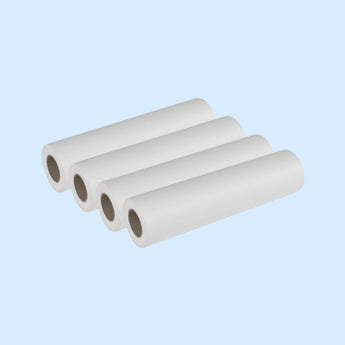
Polypropylene filter roll P20, 20 gsm, for belt filter systems
The only polypropylene quality in the range
People who search specifically for a polypropylene filter roll usually have a reason, and the reason is the fluid. Polypropylene behaves differently towards aqueous media than viscose does, and in some processes that is what decides.
The P20 is the only polypropylene quality in this category and, at 20 gsm, the lightest roll in the range. It is a spunbond: the fibres are laid down straight from the melt and bonded without a chemical binder. As a pp filter fleece roll it is the standard answer when the material, not the fabric weight, is the deciding factor.
A note that saves a confusion
The address of the P150 also contains „pp". That is historic and no longer accurate: the P150 is made from polyester, not polypropylene. The URL stays as it is because it is established.
So if you specifically need polypropylene, this is the page. The P150 is a different material class with a different job.
Where a light, open quality fits
At 20 gsm and 4,500 l/m²/s to DIN 53887, the P20 is an open quality. That makes it a starting point where the available differential pressure is limited, or where the machine already indexes at short intervals and a denser media would only shorten them further.
Typical situations are belt filters carrying a coarse solids load, process water and wash water applications after a material check, and processes where the roll is there to hold back the coarse fraction while the fines are dealt with somewhere else.
The material check is the part that matters. Polypropylene is used in many aqueous media, but that does not mean every concentration, every temperature and every contact time is uncritical. For cleaners, alkaline media or elevated temperatures we clarify it beforehand.
Why the P20 is thicker than the V30 despite weighing less
This one observation says more about material selection than any fabric weight figure.
The P20 weighs 20 gsm and measures 0.27 millimetres. The V30 weighs 30 gsm and measures only 0.25 millimetres. The chemically bonded viscose is built more compactly, the polypropylene spunbond more loosely.
For selection that means fabric weight, thickness and material behaviour are three different quantities. Anyone looking only at the number in front of „gsm" is comparing things that do not compare.
Reading the air permeability figure correctly
For the P20, 4,500 l/m²/s to DIN 53887 is documented. For the V30 it is approximately 5,300 l/m²/s to DIN EN 9237 at 2 millibar.
Those two numbers do not belong side by side. They come from different test methods under different conditions, and a higher figure here does not automatically mean more throughput in service. Within this product family, only V30 against V50 and P20 against P150 can be compared directly.
And in no case is an air figure a liquid throughput. Air and coolant behave quite differently in a nonwoven, if only because of viscosity and wetting.
Technical data, 20 gsm polypropylene filter roll
| Feature | Value |
|---|---|
| Material | polypropylene |
| Bonding | spunbond |
| Fabric weight | 20 gsm |
| Thickness | 0.27 mm |
| Maximum tensile force, MD/CD | 30/25 N/5 cm |
| Wet breaking strength, MD/CD | 34/30 N/5 cm |
| Elongation at maximum force | 35/36 % |
| Air permeability | 4,500 l/m²/s to DIN 53887 |
| Core diameter | 70 mm |
| Standard widths | 500 mm, 710 mm, 1.000 mm |
| Roll length | 100 m |
| Pack quantity | 500 mm four rolls, 710 mm three rolls, 1.000 mm two rolls |
The wet breaking strength is above the dry maximum tensile force. That is not unusual for polypropylene spunbonds and is a useful signal for an application in which the media runs permanently in the fluid. The widths are the standard three across this category: the 500mm coolant filter roll, the 710mm coolant filter roll and the 1000mm coolant filter roll.
Frequently asked questions about the polypropylene coolant filter roll
Most questions concern the material and the distinction from viscose.
When do I choose the P20 rather than the V30?
When the fluid argues for polypropylene, or when you deliberately want a very light, open quality. For classic coolant filtration in machining, the V30 is the usual starting point.
Is the P20 resistant to acids and alkalis?
We do not make a blanket statement on that. Chemical compatibility depends on the specific medium, the concentration, the temperature and the contact time. Send us the data sheet for your medium and we will place it.
Does 20 gsm mean coarse filtration?
Fabric weight says nothing about a cut-off. The actual retention arises in service from fibre structure, particles and the filter cake that builds up.
Is the P150 also polypropylene?
No. The P150 is polyester. The „pp" in its URL is historic and is kept because the address is established. The P20 is the only polypropylene quality.
Is this a filter paper roll?
The trade often calls it that, and it runs on the same belt filters as paper media. The material is a polypropylene nonwoven, and polypropylene cannot be made into paper.
Which machine dimensions do I need to check?
Roll width, running length, core diameter, the maximum roll outside diameter and the unwind direction. A 70 mm core is documented for the P20.
Are non-standard widths available?
We check widths outside the standard three on request, including minimum quantity and availability.
Technical data
These details are taken automatically from the technical table in the product description.
Variants and available versions
Overview of all variants stored in the shop. Ordering still takes place through the variant selector above.
| Width | Price | Availability |
|---|---|---|
| 500mm (4 rolls) | 31,71 € gross / roll 26,65 € net / roll Sales unit: 4 rolls = 126,85 € gross | 106,60 € net | Available |
| 710mm (3 wheels) | 42,36 € gross / roll 35,60 € net / roll Sales unit: 3 rolls = 127,09 € gross | 106,80 € net | Available |
| 1000mm (2 rolls) | 63,43 € gross / roll 53,30 € net / roll Sales unit: 2 rolls = 126,85 € gross | 106,60 € net | Available |


