


Guide
Choosing coolant filter media: paper, gsm and roll dimensions
Filter paper or nonwoven? What gsm does not tell you about microns ➔ plus the five dimensions to measure on your belt filter. Read the...
Read guide →Starting price based on the lowest DHL weight tier (bis 6,99 kg). Final shipping costs depend on the total order weight and are calculated at checkout.
Couldn't load pickup availability
Need a custom size or a different version? Send us the key details directly via the form.
Swarf from turning and milling arrives as chips. Swarf from grinding arrives as dust. Every pass removes material from the workpiece and from the wheel at the same time, so the coolant carries a fine, dense mixture of metal and abrasive grain, and it carries a lot of it.
A light roll cannot hold that. It blinds across the whole surface, flow collapses, and the belt indexes forward again a few minutes later. What looks like a filtration problem is usually a mass problem: there is more solid arriving per square metre than a 30 or 50 gsm sheet can take up before it closes.
The P150 is the answer to that specific load. At 1.31 millimetres it is roughly four times the thickness of the V50 and about five times the V30. A grinding machine coolant filter paper roll has to survive being dragged forward under a heavy, wet cake, and this one is built for it.
This is the most important correction on the page, so it comes early.
The P150 is made from polyester, mechanically bonded by hydroentanglement. The letters „pp" in the product address are historic and are kept because the URL is established and appears in orders, bookmarks and search results. The material has not changed and the address does not describe it.
The only polypropylene quality in this category is the P20 at 20 gsm. If you specifically need PP, that is the page you want.
Most enquiries for this product come from one of three machines.
Surface grinding produces a broad, flat contact area and a steady stream of fine material. A surface grinder coolant filter paper has to cope with volume more than with peak load, which is why fabric weight matters more here than tensile strength. Searches for surface grinder filter paper and surface grinding filter paper usually mean exactly this roll.
Cylindrical grinding concentrates the contact into a narrow line. The solids arrive in a smaller stream but often finer, and the coolant is frequently filtered at a higher rate. A cylindrical grinding filter paper is chosen for the same reason: capacity before the sheet closes.
Precision and tool grinding sit somewhere between the two. Volumes are smaller, requirements on the filtrate are higher, and the roll usually runs longer between indexes.
What this roll is not is a machine. Searches for grinding filter media and for a surface grinder coolant filter often mean a complete filtration unit with tank, pump and belt drive. WINKLER supplies the consumable roll that runs in a unit you already have.
The trade calls this product grinding coolant filter paper, and machine documentation almost always says paper. It is worth being precise about what arrives on the pallet.
Filter paper in the strict sense is made from cellulose fibres formed into a web in a wet process. This roll is a nonwoven: polyester fibres entangled mechanically by fine, high-pressure water jets, with no binder and no papermaking stage. Polyester cannot be made into paper at all.
For your machine that distinction usually does not matter, because both web materials run on the same belt filters. For wet strength and for behaviour under a heavy cake it matters a great deal. So when you order a grinding filter paper roll or a grinder filter paper roll from us, you receive a nonwoven roll, and the technical data below describes it as one.
The two viscose qualities are held together by a chemical binder. The P150 is not.
Fine water jets under high pressure drive the fibres into one another until they interlock mechanically. The result is a bulky web with a high fibre volume and no binder in it, and a maximum tensile force of 370/360 N per 5 cm. That is several times the figure documented for any other roll in this category, and it is the number that matters when the belt drags a loaded sheet forward. A roll that tears under load costs more time than a poor filtrate ever will.
The P150 is the only quality in this category with a documented pore value: 54 micrometres wet pore size to BS 3321.
That is a material characteristic from a defined laboratory method, measured on wet material. It is not a filtration rating and not a cut-off. The data sheet rules a fixed filtration rating out explicitly, because the filter cake that builds up during operation has a decisive influence on what is actually retained.
In practice the figure is useful for placing this material against another one on paper. It does not predict which particle size your grinding machine will hold back. Only a trial roll answers that.
This question comes up on nearly every enquiry, and the answer is simple.
At 1.31 millimetres the material is around four times as thick as the V50 at 0.36 millimetres. At a comparable roll outside diameter, that means proportionally less running length on the core. A 50 metre roll of P150 occupies roughly the same space as a 100 metre roll of thin media.
Two things follow. Check the maximum roll outside diameter in your machine’s magazine before you switch from a thin quality to this one. And calculate your requirement in metres rather than in rolls.
| Feature | Value |
|---|---|
| Material | polyester |
| Bonding | mechanical, hydroentangled |
| Fabric weight | 150 gsm |
| Thickness | 1.31 mm |
| Wet pore size | 54 µm to BS 3321, a material characteristic and not a filtration rating |
| Maximum tensile force, MD/CD | 370/360 N/5 cm |
| Elongation at maximum force | 45/75 % |
| Air permeability | 2.000 l/m²/s to DIN 53887 |
| Core diameter | 70 mm |
| Standard widths | 500 mm, 710 mm, 1.000 mm |
| Roll length | 50 m |
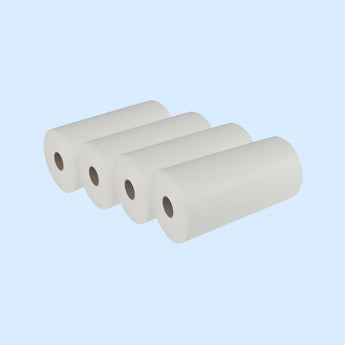
| Pack quantity | 500 mm four rolls, 1.000 mm two rolls |
Every 500mm coolant filter roll, 710mm coolant filter roll and 1000mm coolant filter roll in this category runs on the same three standard widths, so a machine set up for one quality will take the others.
The question comes up when a machine has been running on viscose and the solids load has gone up.
| V50 | P150 | |
|---|---|---|
| Material | viscose | polyester |
| Bonding | chemically bonded | hydroentangled |
| Fabric weight | 50 gsm | 150 gsm |
| Thickness | 0.36 mm | 1.31 mm |
| Maximum tensile force, MD | 125 N/5 cm | 370 N/5 cm |
| Roll length | 100 m | 50 m |
| Typical use | machining at a higher solids load | grinding with fine, dense swarf |
This is not the same idea at a heavier weight. Material, bonding and structure are all different. If your machine has run on thin media so far, check the available differential pressure and the maximum roll outside diameter before you change over.
Most questions concern the material, the pore figure and the changeover from a lighter quality.
Yes. The data sheet documents polyester, mechanically bonded by hydroentanglement. The „pp" in the product address is historic and is kept because the URL is established. The only polypropylene quality in this category is the P20.
It is a laboratory value to BS 3321 for the pore size in the wet state. It is not a filtration rating. What your machine actually retains also depends on the filter cake that builds up in operation.
Neither word is quite right on its own. The trade calls it grinding machine coolant filter paper, the material is a polyester nonwoven. It runs on the same belt filters as paper media.
When fine grinding swarf arrives in quantity and a thinner sheet closes too quickly, or when it reaches its mechanical limit under load. For machining with coarser swarf the V50 is usually enough.
Because the material is around four times as thick as the viscose qualities. At a comparable roll outside diameter, less running length fits on the core.
Roll width, core diameter, here 70 mm, the maximum roll outside diameter in the magazine, the unwind direction and the available differential pressure. This check matters most when changing from thin media to thick.
No. We make the consumable roll for belt filter and paper band filter systems that are already installed. For the machine itself, speak to your system manufacturer.
It is a heavy quality and is worth considering wherever a high load of fine solids arrives. Whether it suits your case depends on the medium, the solids load and the available filter area.
These details are taken automatically from the technical table in the product description.
Overview of all variants stored in the shop. Ordering still takes place through the variant selector above.
| Width | Price | Availability |
|---|---|---|
| 500mm (4 rolls) | 127,69 € gross / roll 107,30 € net / roll Sales unit: 4 rolls = 510,75 € gross | 429,20 € net | Available |
| 710mm (4 rollers) | 128,94 € gross / roll 108,35 € net / roll Sales unit: 4 rolls = 515,75 € gross | 433,40 € net | Available |
| 1000mm (2 rolls) | 255,38 € gross / roll 214,61 € net / roll Sales unit: 2 rolls = 510,75 € gross | 429,20 € net | Available |
Selection guidance and technical background for choosing and using the product correctly.
Filter paper or nonwoven? What gsm does not tell you about microns ➔ plus the five dimensions to measure on your belt filter. Read the...
Read guide →Your cart is currently empty.
Start Shopping


