


i
Starting price based on the lowest DHL weight tier (bis 6,99 kg). Final shipping costs depend on the total order weight and are calculated at checkout.
Couldn't load pickup availability
Request a custom solution
Need a custom size or a different version? Send us the key details directly via the form.
Reusable Cable Ties, 120 mm: Releasable Instead of Single-Use
What makes a reusable cable tie different from a normal one
A standard cable tie is closed once and then cut off. These are not. The latch opens again without destroying the tie, which is why the same tie can be closed a second and a third time.
That is the whole point of the product, and it is worth more than it sounds. Anywhere a connection is undone regularly, releasable cable ties save you the cut, the hunt for the side cutters and the pile of offcuts. They also let you readjust on closing, which a one-shot tie does not.
Reusable does not mean unlimited. The latch and the body should be looked at before every further use. A tie that is visibly deformed, that no longer clicks in cleanly or that has lost its grip belongs in the bin. We do not quote a number of opening cycles and we do not promise unchanged holding force after any of them.
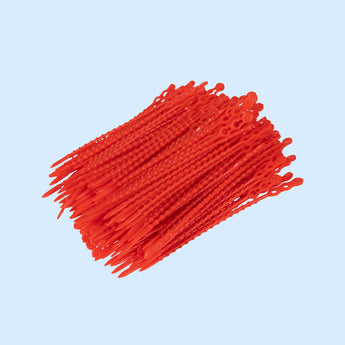
The 120 mm version: red PE, 27 mm bundle diameter, 13 daN
| Feature | Value |
|---|---|
| Material | Polyethylene |
| Colour | Red |
| Length | 120 mm |
| Profile width | 3.5 mm |
| Bundle diameter | up to 27 mm |
| Pull-out force | 13 daN |
| Temperature range | −40 °C to +70 °C |
| Latch | releasable, reusable while undamaged |
| Pack size | 500 pieces |
Two of those figures decide whether the tie fits your job.
The bundle diameter of 27 mm is the largest bundle these ties will close around. At 120 mm overall length that leaves a tail you can actually grip after closing, which makes opening with work gloves on a great deal easier. If you need to bundle more than 27 mm, this is not the size for you.
The pull-out force of 13 daN describes how hard you can pull on a closed tie before it gives. It is a property of the product and not a permissible load. A plastic tie is not a fastening element for safety-relevant tasks, and no load release for carrying or suspending anything follows from this figure.
The temperature range of −40 °C to +70 °C covers indoor use, outdoor storage and most workshop conditions. Polyethylene gets more brittle in the cold and softer in the heat, so at either end of the range it is worth watching how the tie behaves in the actual application.
How to reuse releasable cable ties
Opening one is straightforward: lift the small tab on the head, and the strap runs back out. The tie is not cut, so it stays usable.
What matters is the check in between, and it takes about two seconds:
Is the strap deformed, stretched thin or kinked anywhere along its length?
Does the latch still click in audibly and hold when you tug on it?
Is the plastic discoloured, chalky or brittle to the touch?
Was the tie exposed to heat, UV or a process medium since it was last used?
If any of those points is a clear yes, replace the tie rather than reuse it. Ties are the cheapest part of any assembly they hold together.
We deliberately do not state how often a tie can be reused. The honest answer depends on how tightly it was closed, what it held, and what it was exposed to in between.
Filter cloth ties for a filter press
The confirmed use in filtration is fastening filter cloths. Filter cloths have fastening points along their edge; the tie is passed through and closed.
This is where the releasable latch earns its keep. A cloth change is a recurring job with a lot of fastening points per plate, and a filter press cloth tie that opens instead of needing to be cut saves a noticeable amount of time across a full plate pack. The 500 pack exists for exactly this case.
What we do not claim: that these ties fit every filter press. Fastening points, plate geometry and edge finishing differ between machines. Before the first run, check that the 120 mm length, the 27 mm bundle diameter and the holding force suit your plate.
Nor do we claim that better fastening extends the service life of your cloths or prevents consequential damage. Proper fastening is sensible. Its contribution to service life cannot be put in a number.
In everyday plant language the same part is called filter cloth fastening ties, filter press fastening ties or simply reusable filter cloth ties. All of those are this product.
Where else reusable ties are used
The tie is a general fastening part first and filter accessory second. Typical jobs in maintenance, workshop and logistics:
Bundling cables, hoses and lines that will be separated again later
Attaching signs, labels and markings that change regularly
Fixing covers, sheeting and netting to frames
Holding components together for transport or storage
Setting temporary markings that stand out at a glance
The red colour is a practical advantage here. A red tie is easy to find on a dark background and in cluttered areas, which makes it easier to release again.
Reusable ties for textiles are a common case as well: temporary fastenings on tarpaulins, covers and technical fabrics, where the connection is meant to come apart again.
The same product is searched for under a lot of names. Reusable tie wraps, releasable zip ties, resealable zip ties and removable cable ties all describe it, and the size turns up written both ways, as cable ties 120mm and as 120mm reusable cable ties without the space. They are all this tie.
What these ties are not
This is worth being blunt about, because the words used to search for reusable ties cover several different products.
Not a wire tie. Reusable wire ties usually means a coated wire or a twist tie. This is a moulded polyethylene tie with a latch.
Not a heavy-duty tie. 13 daN pull-out force is a product property, not a load rating, and there is no heavy-duty release for these ties.
Not 300 mm and not long. The only length offered is 120 mm, closing around bundles up to 27 mm.
Not black. The current version is red.
Not released for permanent outdoor use. The temperature range is documented, a UV or weathering release is not.
Not sold in small quantities. The pack size is 500. For two or three ties that is the wrong quantity. For a maintenance store it is the right one.
Finally, these ties are not intended for safety-relevant fastenings, for load-bearing connections, or for any application where failure could cause injury or significant damage.
Frequently asked questions about reusable cable ties
The questions we get concern reuse, the dimensions and the filter application.
What is the difference between a reusable cable tie and a normal cable tie?
A reusable cable tie has a latch that opens again. A standard cable tie has to be cut to release it. That is the difference and, for most buyers, the reason to choose one.
How do you reuse a releasable cable tie?
Lift the tab on the head and pull the strap back out. Before closing it again, check the strap and the latch for deformation, brittleness and loss of grip. If in doubt, replace it.
How many times can a tie be reused?
We do not give a number. How often depends on how tightly the tie was closed, what it held and what it was exposed to in between. A condition check before each reuse is the reliable answer.
What bundle diameter do the ties close around?
Up to 27 mm, at an overall length of 120 mm. For larger bundles the length is not sufficient.
What does the 13 daN pull-out force mean?
It describes the tensile force the closed tie withstands. It is a product property and not a permissible load; these ties are not intended for safety-relevant or load-bearing fastenings.
How are filter cloths fastened with these ties?
The tie is passed through the fastening points of the cloth and the filter plate and closed. Whether length, bundle diameter and holding force suit your plate should be checked before the first run.
Do the ties fit every filter press?
No. Fastening points, plate geometry and edge finishing differ between machines. Where the fit is unclear we sort it out from photos and dimensions.
What are the ties made of?
Polyethylene. The temperature range is −40 °C to +70 °C. We do not give a blanket chemical or UV resistance statement.
How many ties are in a pack?
That quantity generally covers a complete cloth change on a larger filter press.
Technical data
These details are taken automatically from the technical table in the product description.


