


Guide
Filter Press Cloth Cleaning, Blinding and Knowing When to Replace
How to clean filter press cloths without damaging them, why a cloth blinds and how to tell that washing will not help any more. Read...
Read guide →Starting price based on the lowest DHL weight tier (bis 6,99 kg). Final shipping costs depend on the total order weight and are calculated at checkout.
Couldn't load pickup availability
Need a custom size or a different version? Send us the key details directly via the form.
The reason people go looking for a finer cloth is usually specific. The filtrate stays cloudy. Solids settle in downstream pipework and pumps. A quality check flags fine material that came through the fabric you have.
That is what the 3L is for. It is the densest quality we supply for direct cake filtration, and within this range there is nothing finer. A 10 micron filter press cloth is where the sequence ends, not where it starts.
There is a trade in that, and it belongs before the order rather than after it. A denser fabric means more resistance. Chambers fill more slowly, differential pressure rises earlier, and the cycle can get longer. You are trading throughput for retention. That is the right trade when fine solids are the problem and the wrong one when the clock is.
This is where the fabric gets interesting, because the 3L takes a different route to fineness than the rest of the family.
It has 60 warp threads and 12 weft threads per centimetre, which is a fairly open grid. The 6L runs 120 and 28, more than twice as many, and it is still the more open cloth.
The difference is in the yarn. Multifilament and staple fibre yarns are made up of many individual filaments, or of short fibres spun together. Those filaments fill the spaces between the threads. The result is a fabric that separates across an irregular, fibrous structure rather than at one clean opening plane, and that is what makes the 3L the fine end of this range. It also explains the weight: at 620 ± 40 g/m² this is the heaviest cloth we stock, and at 0.95 mm the thickest. Both figures follow from the same construction.
The datasheet gives 3 ± 1 l·dm⁻²·min⁻¹ for this fabric. That is the lowest figure in the range; the 15L sits at 15 ± 6, five times higher.
The value is measured on dry air through flat fabric and describes the resistance of the cloth itself. It does not predict the liquid throughput of your press, because that depends on the suspension, the cake, the pressing pressure and the chamber geometry as well. As a yardstick between qualities it is useful. As a performance figure it is not.
The 10 micron figure is a nominal range classification, not a tested cut-off. It places the cloth inside the family: denser than the 6L at 20 micron, denser than the 7L and the 15L at 25 micron each.
What actually gets held back is decided in the process. Within a short time a filter cake builds on the fabric and takes over a growing share of the separation. That is why filtrate at the start of a cycle often looks different from filtrate once the cake is established. The 3L covers the start of the cycle better and lets less fine material through. It does not come with a guaranteed turbidity figure.
| Property | Value |
|---|---|
| Material | Polypropylene |
| Yarn construction | Multifilament and staple fibre |
| Weave | Special weave |
| Threads per cm | 60 warp, 12 weft |
| Fabric weight | 620 ± 40 g/m², as stated by the fabric supplier |
| Thickness | 0.95 mm, as stated by the fabric supplier |
| Air permeability | 3 ± 1 l·dm⁻²·min⁻¹, as stated by the fabric supplier |
| Finish | Calendered |
| Nominal rating | 10 micron, range classification |
| Plate sizes | 400, 470, 500, 630, 800 and 1000 |
| Base unit | Each |
| Grade | Documented construction | Role in the process |
|---|---|---|
| 3L, this page | 10 micron nominal; multifilament and staple fibre; 620 ± 40 g/m²; 3 ± 1 l·dm⁻²·min⁻¹ | densest direct grade |
| 6L | 20 micron nominal; monofilament warp, multifilament weft; 400 g/m²; 6 l·dm⁻²·min⁻¹ at 200 Pa | fine intermediate step |
| 7L | 25 micron nominal; multifilament; no further values documented | economical standard grade |
| 15L | 25 micron nominal; monofilament and multifilament; 320 ± 40 g/m²; 15 ± 6 l·dm⁻²·min⁻¹ | more permeable alternative |
| 67L | 46 micron pore size; monofilament; 275 g/m²; 111 l(n)·m⁻²·s⁻¹ at 2 mbar | support fabric for precoat filtration |
The 67L belongs to a different process and is not a fifth step on the fineness scale.
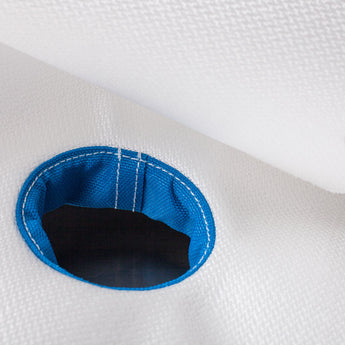
Inside a plate pack the head and end plates often need a different cut from the chamber plates: another inlet, a barrel neck instead of a through feed, a different edge. We make those cloths from the 3L fabric as well.
For a quotation we need the plate size, the position in the pack, the inlet geometry, the edge finish and the fixing method. A drawing is the clearest route, but a cleaned old cloth and good photographs will do in most cases.
Most of what people ask about this cloth comes back to the same trade between fineness and throughput.
When fine solids are passing through the cloth you have, when the filtrate stays cloudy, or when downstream equipment is being loaded with solids. If throughput is the problem instead, a denser cloth moves in the wrong direction.
No. It is a nominal range classification that places the cloth inside the family. Actual retention also depends on the particle distribution, the cake, the pressing pressure and how the press is run.
As a rule, yes. The documented air permeability of 3 ± 1 l·dm⁻²·min⁻¹ is the lowest in the range. How far that shows up in your cycle is something only a comparison on the real medium will tell you.
The 6L is more open at 20 micron nominal and much lighter at 400 g/m². The interesting part is how each one gets there: the 6L has the tighter thread grid, the 3L the more fibrous yarn. If the 3L creates too much resistance, the 6L is the first step back.
Polypropylene stands up to many aqueous and industrial media. Whether it suits yours depends on the medium, the concentration, the temperature and the contact time together, and we check that case by case. We do not give blanket resistance assurances.
400, 470, 500, 630, 800 and 1000 as standard. Other dimensions and special contours are made to drawing or to sample.
These details are taken automatically from the technical table in the product description.
Overview of all variants stored in the shop. Ordering still takes place through the variant selector above.
| Size | Price | Availability |
|---|---|---|
| 400 plate | 24,99 € 21,00 € net | Available |
| 470 plate | 29,99 € 25,20 € net | Available |
| 500 plate | 33,80 € 28,40 € net | Available |
| 630 plate | 40,10 € 33,70 € net | Available |
| 800 plate | 52,60 € 44,20 € net | Available |
| 1000 plate | 68,90 € 57,90 € net | Available |
Selection guidance and technical background for choosing and using the product correctly.
How to clean filter press cloths without damaging them, why a cloth blinds and how to tell that washing will not help any more. Read...
Read guide →
Nominal micron rating, measured pore size and air permeability are three different things ➔ what each one says and what it does not. Read the...
Read guide →
Monofilament, multifilament or hybrid ➔ pick a filter press cloth from filtrate quality, throughput and cake release, not from micron. Read the guide!
Read guide →Your cart is currently empty.
Start Shopping


