


Guide
Filter Press Cloth Cleaning, Blinding and Knowing When to Replace
How to clean filter press cloths without damaging them, why a cloth blinds and how to tell that washing will not help any more. Read...
Read guide →Starting price based on the lowest DHL weight tier (bis 6,99 kg). Final shipping costs depend on the total order weight and are calculated at checkout.
Couldn't load pickup availability
Need a custom size or a different version? Send us the key details directly via the form.
When the press opens and cake residue stays on the cloth, reaching for a metal spatula is the obvious move. It is usually within reach, it is stiff, and it solves the problem in the moment.
It also does other things. A metal edge leaves cuts and point damage on a PP fabric that are barely visible at first. They show up later: as solids in the filtrate, as a leak in the plate pack, as a cloth that has to be replaced after half the expected time.
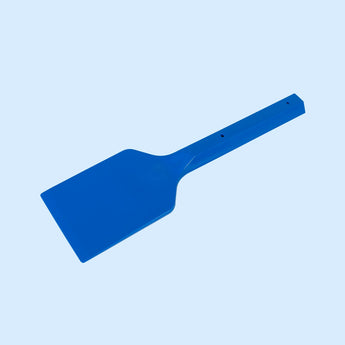
A polyethylene scraper is distinctly softer than the fabric underneath it. It can scratch, but it does not cut. That is the whole idea behind the tool, and it is why a hand scraper is worth carrying as a product of its own.
The scraper comes in two versions, and the difference is not the colour.
| Blue, PE-MD | Red, PE-HD | |
|---|---|---|
| Material | Medium density polyethylene | High density polyethylene |
| Tendency | slightly more yielding | slightly stiffer |
| Sensible for | soft, pasty and wet cakes; delicate fabrics | dry, hard and crusted deposits |
| Dimensions | 400 × 125 mm | 400 × 125 mm |
Medium density polyethylene gives a little under pressure and follows the surface more closely. High density polyethylene is stiffer and transmits force more directly.
In practice it pays to start with the more yielding blue scraper and to move to the red one only when the blue one is not enough. Plenty of plants end up with both, on different presses or for different batches.
Before any work on the plate pack: the press has to be shut down, depressurised and secured against unintended start-up. That is not a formality. It is the condition under which work on an open press is permitted at all.
Four points have proved themselves for the work itself.
Keep the angle flat. The flatter the angle, the lower the point load on the fabric. A scraper held steeply acts like an edge.
Stay away from seams, folds and sealing areas. There the fabric lies in several layers or under tension, and that is where damage starts fastest.
Do not work with force. If a cake only comes away under real pressure, the cause is usually the cycle or the fabric grade rather than the tool.
Check the edge. A scraper whose edge is notched or broken out acts like a metal tool again. At that point it belongs in the bin.
A scraper is the answer to the individual case. If the cake sticks every single cycle, the scraper is treating a symptom.
The usual causes are a cycle ended too early with too much residual moisture, a fabric whose surface does not suit the cake, a cloth that is already blinded, or sticky solids that need a change to the process. Where release is the recurring problem, the calendered face of the 15L is the first thing to look at in this range.
| Property | Value |
|---|---|
| Material, blue | Medium density polyethylene, PE-MD |
| Material, red | High density polyethylene, PE-HD |
| Dimensions | 400 × 125 mm |
| Weight | 0.24 kg |
| Application | Manual removal of filter cake from filter plates and filter cloths |
| Base unit | Each |
The questions here are about choosing the version, about safety and about material suitability.
For removing adhering cake residue from filter plates and filter cloths by hand once the press has been opened.
Start with the blue PE-MD scraper, which is the more yielding of the two. The red PE-HD version is stiffer and intended for dry, hard deposits. With delicate fabrics the more yielding version is the safer choice.
Polyethylene is softer than a metal tool and does not cut. We still do not promise freedom from damage: that depends on how the tool is guided, the angle, the force used, the condition of the fabric and the type of deposit. Seams, folds and sealing areas should be left alone.
Yes, that is one of the main uses. On coated or delicate plate surfaces, check compatibility on an uncritical spot first.
Polyethylene stands up to many aqueous media. Whether it suits yours depends on the medium, the concentration, the temperature and the contact time, and it is checked case by case.
Then the scraper is treating a symptom. Check the cycle time, the residual moisture and the condition and grade of the fabric. Where release is difficult, the calendered face of the 15L is the first place to look.
As soon as the edge is notched, broken out or sharp. A damaged plastic scraper loses exactly the property it was bought for.
These details are taken automatically from the technical table in the product description.
Overview of all variants stored in the shop. Ordering still takes place through the variant selector above.
| Color | Price | Availability |
|---|---|---|
| blue | 37,84 € 31,80 € net | Available |
| red | 37,84 € 31,80 € net | Available |
Selection guidance and technical background for choosing and using the product correctly.
How to clean filter press cloths without damaging them, why a cloth blinds and how to tell that washing will not help any more. Read...
Read guide →Your cart is currently empty.
Start Shopping


