


Guide
Well pump drawing sand: causes, damage and what actually helps
Well pump drawing sand ➔ causes, what the sand damages and which filter works where. Intake or pipework. Read the guide now!
Read guide →Starting price based on the lowest DHL weight tier (bis 6,99 kg). Final shipping costs depend on the total order weight and are calculated at checkout.
Couldn't load pickup availability
Need a custom size or a different version? Send us the key details directly via the form.
Sand does its damage before you ever see it. By the time grit appears at the tap or blocks a drip line, it has already travelled through the impellers, past the mechanical seal and through the bearings of the pump. Abrasive particles work like grinding paste in those clearances, and nothing that sits downstream can undo it.
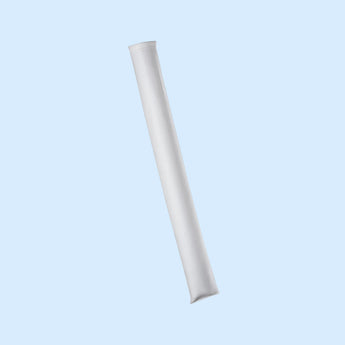
This is a well pump pre filter in the literal sense. The sock is pulled over the pump so that it covers the intake ports, and water has to pass through 2.50 mm of needle felt before it can enter. That single fact, where the filter sits, decides what this product can and cannot do, and it is what separates it from almost everything else sold under the same search terms.
Search for a well pump filter and you will find four or five designs that all promise clean water. They do different jobs, and only one of them protects the pump itself.
| Design | Position | Protects | Limit |
|---|---|---|---|
| Filter sock over the pump | at the intake, in the borehole | the pump and everything after it | does not fix the cause |
| Cartridge or housing filter | after the pump | pipework, valves, irrigation | pump stays unprotected |
| Cyclone or sand separator | after the pump | downstream equipment at high sand loads | pump stays unprotected, pressure loss |
| Settling tank | after the pump | downstream equipment | space required, pump stays unprotected |
| Well rehabilitation | in the well | everything | specialist contractor, cost |
A sediment filter for well pump installations, a well pump sediment filter and a water filter for well pump systems are all useful products. They are also all fitted after the pump, which is the point most buyers miss. The sand has already been through the machine you are trying to protect.
If you want a sand filter for well pump protection rather than pipe protection, it has to sit in front of the intake. That is what this sock does, and it is the only thing it does.
A screen fabric filters in one plane. Once that plane is covered, it is closed.
The sock is made from polypropylene needle felt at 390 grams per square metre and 2.50 millimetres thick, with a pore volume of 83 per cent. It filters through its depth: particles are held throughout the cross section rather than on the surface alone. Sand and fine sand arrive in a wide range of grain sizes, and depth filtration copes with that range far better than a single-plane mesh.
The documented air permeability is 850 l/dm²/min at 200 pascals of test pressure. That figure describes flat, clean material on a test rig and is a comparison value for openness. It cannot be converted into a water flow rate, and we do not present it as one.
This is the one point where orders go wrong, so it is worth doing properly.
| Pump diameter | Sock diameter | Sock length |
|---|---|---|
| 74 mm | Ø 78 mm | 1,100 mm |
| 89/90 mm | Ø 94 mm | 1,200 mm |
| 98 mm | Ø 102 mm | 1,100 mm |
| 100 mm | Ø 104 mm | 1,200 mm |
| 110 mm | Ø 115 mm | 1.500 mm |
| 125 mm | Ø 130 mm | 1.000 mm |
The left-hand column is your pump. A filter sock for 100mm well pumps is the 100 mm row, with an internal diameter of 104 mm and a length of 1,200 mm. If you know the manufacturer and model, that is usually enough for us to place you in the right row.
Three measurements settle it: outside diameter of the pump, overall length, and where the intake ports sit. A sock that is too tight will not pull on cleanly and chafes at the edges. One that is too wide falls into folds, and material collects in folds and restricts the inflow locally.
Check the well casing as well. The sock adds a few millimetres all round, and the pump has to hang and move freely with the sock fitted. For diameters or lengths outside this table we make the sock to your dimensions.
Terminology in this field is inconsistent, and it costs people time. A submersible pump filter sock, a borehole pump filter sock, a deep well pump filter sock, a well pump filter sock, a bore hole filter sock and a deep well pump sock all describe this product. So does a filter for submersible well pump installations and a submersible well pump filter of the textile kind.
What they have in common is the position: over the pump, covering the intake. What they do not describe is a treatment system, a housing, a cartridge or a well screen. If a listing uses one of these words for something that bolts into a pipe, it is a different product.
It keeps sand and finer particles away from the intake zone, so less abrasive material reaches the impellers and seals. In our experience from the field, that reduces wear and extends how long a pump lasts in sandy conditions.
We do not put a percentage on it. How much difference it makes depends on the well, on how much sand it carries, on the pump and on how the installation is maintained.
We also do not promise a flow rate. With the right size and a clean sock, the inflow stays largely unaffected in practice. A sock that is undersized, folded or heavily loaded can reduce it noticeably. That is precisely why the size table and the checking routine belong on this page.
It does not fix the cause. A well that produces sand continuously is telling you something about pump depth, abstraction rate, screen slot size, gravel pack or annular seal. A filter sock protects the pump; it does not rehabilitate a well.
It is not water treatment. Dissolved substances, iron, manganese and bacteria pass straight through. Drinking water has its own requirements and its own testing, and this product does not meet them.
It does not replace a filter further down the line. A cartridge filter at the pressure vessel or ahead of an irrigation manifold works at a different point on a different job. The two are complementary, not alternatives.
| Feature | Value |
|---|---|
| Material | polypropylene needle felt |
| Fabric weight | 390 g/m² |
| Thickness | 2.50 mm |
| Pore volume | 83 % |
| Air permeability | 850 l/dm²/min at 200 Pa |
| Product rating | 50 µm |
| Dry continuous load | below 100 °C |
| Sizes | six, for pump diameters from 74 to 125 mm |
| Custom sizes | to your measurements |
| Use | cleanable and reusable |
Pull the sock over the pump so that the intake zone is fully covered and the material lies flat. Avoid folds, particularly around the intake ports, and secure the top edge before lowering the pump.
How often to check depends on the sand load. A well that produces a little fine sand occasionally needs looking at far less often than one with a steady input. The most useful indicator is delivery: if the flow drops noticeably and nothing else has changed, the sock is loaded.
To clean it, pull it off, rinse it and let it dry. Then check material, seams and the top edge. A sock with chafed patches or holes is replaced, because water will enter unfiltered exactly there.
Most enquiries come from garden owners, horticulture and irrigation, and they are almost always about fit or about what the sock can be expected to do.
Outside diameter, overall length and the position of the intake ports decide. Six sizes cover pump diameters from 74 to 125 mm. Send us the manufacturer and model, or those three measurements, and we will match it.
With the right size and in clean condition, the inflow stays largely unaffected in practice. A sock that is too tight, folded or heavily loaded can reduce it. That is why sizing and a checking routine matter more here than the micron figure.
It protects the pump. It does not remove the cause. If the sock loads quickly, treat that as a signal to look at pump depth, abstraction rate and the well itself.
Position. A housing or inline filter sits after the pump and protects pipework, valves and irrigation equipment. The sock sits before the intake and protects the pump. Many installations sensibly have both.
There is no fixed interval, because the sand load sets the pace. Watch the delivery rate: if it falls away without another obvious reason, pull the sock, rinse it and inspect it.
Polypropylene is used in a wide range of aqueous media, and a dry continuous load below 100 °C is documented. We do not give blanket resistance statements for specific media. If your water has an unusual composition, tell us what is in it before you order.
Yes. Pull it off, rinse it, let it dry and inspect it. As long as material, seams and edge are undamaged it goes back on. Replace it once you find chafing or holes.
These details are taken automatically from the technical table in the product description.
Overview of all variants stored in the shop. Ordering still takes place through the variant selector above.
| Size | Price | Availability |
|---|---|---|
| 74mm: Ø 78mm x 1100mm | 89,90 € 75,55 € net | Available |
| 89/90mm: Ø 94 mm x 1200mm | 92,90 € 78,07 € net | Available |
| 98mm: Ø 102mm x 1100mm | 91,90 € 77,23 € net | Available |
| 100mm: Ø 104 mm x 1200mm | 92,90 € 78,07 € net | Available |
| 110mm: Ø 115 mm x 1500mm | 102,90 € 86,47 € net | Available |
| 125mm: Ø 130 mm x 1000mm | 99,90 € 83,95 € net | Available |
Selection guidance and technical background for choosing and using the product correctly.
Well pump drawing sand ➔ causes, what the sand damages and which filter works where. Intake or pipework. Read the guide now!
Read guide →Your cart is currently empty.
Start Shopping


