


i
Starting price based on the lowest DHL weight tier (bis 6,99 kg). Final shipping costs depend on the total order weight and are calculated at checkout.
Couldn't load pickup availability
Request a custom solution
Need a custom size or a different version? Send us the key details directly via the form.
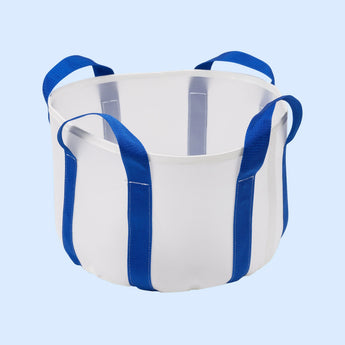
High-Throughput Centrifuge Filter Bag for Parts Centrifuges
One centrifuge bag, two fabrics that do opposite jobs
On most filter bags a single material line describes the whole product. Not on this one. The side and the base are two different fabrics, and the difference between them is the design idea of the bag.
In a centrifuge, centrifugal force pushes the liquid outwards. It leaves the bag through the side wall, not through the base. That is where the most open fabric WINKLER processes is fitted.
The base has a different job. It carries the whole weight of the load during filling, during insertion and when the bag is lifted out. Mechanical strength comes first there, which is why the heaviest fabric in the range sits at the bottom.
What separates the two fabrics
| Feature | Side fabric | Base fabric |
|---|---|---|
| Material | 100 % polypropylene | 100 % polypropylene |
| Yarn | monofilament in warp and weft | multifilament and staple fibre |
| Weave | special satin | special weave |
| Threads per cm | 25.2 warp, 11.5 weft | 60 warp, 12 weft |
| Weight per unit area | 440 ± 25 g/m² | 620 ± 40 g/m² |
| Thickness | 0.95 mm | 0.95 mm |
| Air permeability | 250 ± 8 l·dm⁻²·min⁻¹ | 3 ± 1 l·dm⁻²·min⁻¹ |
| Finish | heat-set and calendered | calendered |
Both fabrics are exactly the same thickness. In permeability there is a factor of 83 between them.
The side fabric reaches its value through smooth monofilaments in a wide grid of 25.2 to 11.5 threads per centimetre. The base fabric has a grid more than twice as tight at 60 to 12 threads, and it works with multifilament and staple fibre yarn whose fibres fill the gaps.
Where the high throughput of this centrifuge liner comes from
The name of this version is not a marketing word. It has a traceable basis: 250 ± 8 l·dm⁻²·min⁻¹ measured on the side fabric, and the side wall is exactly the surface the liquid leaves through. That is what makes this a high flow centrifuge filter bag in the sense the figure supports.
Two limits belong with it. First, air permeability is a test value on dry, flat fabric and not a liquid throughput for your plant. Second, after a short time the load itself decides how quickly things drain: as soon as a solids layer forms, that layer is the limiting resistance, not the fabric.
So a fast draining centrifuge bag creates good conditions. We do not promise a shorter cycle time, because that depends on load, medium, speed and how the plant is set up.
The centrifuge filter bag in a parts centrifuge
The typical case for this version is the parts centrifuge: components are spun after a washing, degreasing or machining step so that the liquid clinging to them runs off. Parts washing centrifuge bag and metal parts centrifuge bag describe the same job from two directions, and de-oiling, cleaning and drying of workpieces all work on the same principle.
The bag does two things there. It holds the components together so they can go in and come out as one batch. And it puts a textile layer between the component and the basket wall.
That layer can reduce direct contact between the workpiece and the metal. How much it achieves in a given case depends on component geometry, weight, packing density, speed and movement during the run. We describe it as a contribution, not as surface protection with a guaranteed effect.
A component centrifuge liner in this sense is a handling part as much as a filter part. Where the aim is to retain fine solids rather than components, the 25 micron version is the right choice.
Where this centrifuge bag needs a check first
Two applications come up in enquiries that we do not confirm from a catalogue page.
Swarf and chip handling. Metal chips vary enormously in shape, edge sharpness and abrasiveness, and a chip wringer is a machine with its own basket geometry and loading pattern. Whether this bag suits that duty depends on the chips, the load and the basket, and it is checked case by case rather than promised in advance.
Peeler centrifuges and other designs with mechanical discharge. The discharge mechanism touches the filter medium, so the release depends on the machine, not on the fabric alone.
One term to keep apart: bag centrifuge and solid liquid centrifuge describe machines. WINKLER supplies the textile insert that runs inside one.
The straps and what they are for
The bag has straps. They are intended for placing the filled bag and for moving it, and they make handling considerably easier with work gloves on.
What we do not state: a permissible working load. No load test exists for these straps. They are therefore not lifting accessories in the sense of a lifting plan, and they are not released for crane operation or for loads carried overhead.
Whether and how the bag may be moved in your plant follows from the actual load and from your own risk assessment. That assessment is the operator’s.
Four standard sizes and what the 150 micron figure refers to
| Standard size | Ø × height |
|---|---|
| Size 1 | 400 × 230 mm |
| Size 2 | 400 × 250 mm |
| Size 3 | 440 × 250 mm |
| Size 4 | 480 × 250 mm |
Sizes 1 and 2 share a diameter and differ only in height. From size 3 the diameter grows while the height stays at 250 mm.
On the grade: a 150 micron centrifuge filter bag carries that figure as a material value. It refers to the open side fabric, the surface the liquid leaves through. A 150 micron centrifuge liner is therefore deliberately coarse, because the liquid is meant to drain quickly, not because the grade was economised on. For finer retention there is the 25 micron version.
Technical data
| Feature | Value |
|---|---|
| Form | cylindrical filter bag with straps |
| Material, side and base | 100 % polypropylene |
| Side fabric | monofilament, special satin, 25.2/11.5 threads per cm, 440 ± 25 g/m², 0.95 mm, 250 ± 8 l·dm⁻²·min⁻¹, heat-set and calendered |
| Base fabric | multifilament and staple fibre, special weave, 60/12 threads per cm, 620 ± 40 g/m², 0.95 mm, 3 ± 1 l·dm⁻²·min⁻¹, calendered |
| Grade | 150 micron, material figure |
| Standard sizes | Ø 400 × 230, 400 × 250, 440 × 250 and 480 × 250 mm |
| Handling | straps for placing and moving; not a lifting accessory |
| Base unit | each |
| Custom sizes | to drawing, to dimensions, to a sample or to a basket you send in |
Frequently asked questions about this centrifuge filter bag
The questions we get concern parts centrifuges, the straps and the difference to the finer version.
What is a filter bag for a centrifuge used for in parts processing?
It holds the components together as a batch while the liquid clinging to them drains through the side wall. Typical reasons are de-oiling, cleaning and drying of workpieces after a washing or machining step.
What does high throughput mean on this product?
The side fabric has the highest documented air permeability in the range at 250 ± 8 l·dm⁻²·min⁻¹, and the side wall is the surface the liquid leaves through. It is a material value and not a promised cycle time.
Why are the side and the base different fabrics?
Because they have different jobs. The side has to let the liquid through, the base carries the weight of the load. That is why the side is the most open fabric in the range and the base the heaviest.
May I lift the filled bag by the straps?
The straps are intended for placing and moving the bag. No load test exists; they are not lifting accessories and are not released for crane operation or overhead loads. What is permissible follows from your own risk assessment.
Does the bag protect sensitive component surfaces?
The textile layer can reduce direct contact between the component and the basket wall. How much depends on component geometry, packing density, speed and movement. We do not derive guaranteed surface protection from it.
What is the difference to the 25 micron version?
This version is built for quick drainage and for handling components, uses two different fabrics and has straps. The 25 micron version retains finer solids and is held by a drawstring.
Will the bag fit my basket?
The four standard sizes cover Ø 400 × 230 to 480 × 250 mm. For smaller baskets the 25 micron version is the right range, starting at Ø 200 mm. For a different geometry we make to measure.
Technical data
These details are taken automatically from the technical table in the product description.
Variants and available versions
Overview of all variants stored in the shop. Ordering still takes place through the variant selector above.
| Ø xh | Price | Availability |
|---|---|---|
| 400x230mm | 120,19 € 101,00 € net | Available |
| 400x250mm | 123,88 € 104,10 € net | Available |
| 430x250mm | 130,90 € 110,00 € net | Available |
| 480x250mm | 146,49 € 123,10 € net | Available |


