-
 perfect fit
-
extremely resistant
-
real craftsmanship

Delivery time: 3 working days
Couldn't load pickup availability
Request individual solution
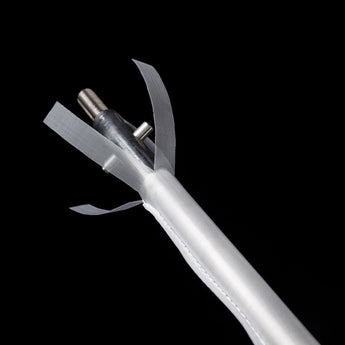
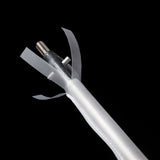
PTFE Cathode Rod Sock for Electroplating – A Precision Solution for Redox Processes
Maximum Current Efficiency Under Extremely Oxidative Conditions
In electroplating, small details determine current efficiency, process stability and surface quality. Our PTFE cathode rod sock was developed specifically for demanding redox processes where conventional materials fail.
With a precisely defined 250 µm mesh size and exceptional chemical resistance, this sock significantly boosts the efficiency of electrochemical processes and ensures reproducible production conditions.
You'll find further solutions for electroplating applications in our Filtration for Metal & Electronics – Electroplating & Metalworking range, as well as our anode and cathode bags.
PTFE Monofilament – Extremely Resistant and Durable
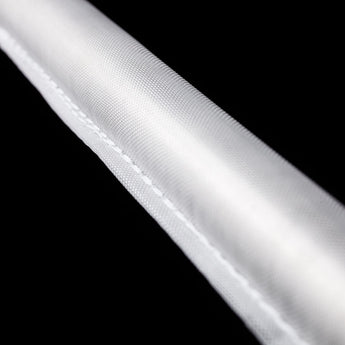
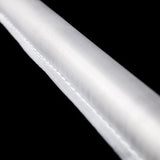
The PTFE (polytetrafluoroethylene) used is one of the most chemically resistant materials in industrial filtration. The monofilament fabric stays dimensionally stable even under strongly oxidative conditions, ensuring consistent filter performance.
- Maximum oxidation resistance: Ideal for aggressive electrochemical processes.
- Dimensional stability: No warping or swelling under chemical stress.
- Long-term service life: Reduces maintenance and replacement intervals.
Precision Manufacturing With 0.1 mm Tolerance
Only an exact fit of the fabric on the cathode rod guarantees minimal contact resistance and maximum efficiency. That's why we manufacture every sock to a tolerance of just 0.1 mm.
- Perfect fit: Custom-made for exact contact.
- Optimised current flow: Minimised resistance through close fabric contact.
- Workshop-grade quality: Precise handcrafting for high-performance industrial processes.
Technical Highlights at a Glance
- Material: PTFE monofilament
- Micron rating: 250 µm
- Application: Electroplating & electrochemical redox processes
- Manufacturing: Custom-made to a tenth-of-a-millimetre precision
- Chemical resistance: Extremely oxidation-resistant
Technical Data
| Material | PTFE |
| Fabric construction | Monofilament / monofilament |
| Fabric weight | 165 g/m² |
| Micron rating | 250 µm * |
| Base unit | Each |
Note: * As stated by the fabric supplier
Custom Advice for Your Plating Line
Need custom sizes or have questions about chemical resistance for your specific electrolyte? Use our filtration product advice service – together we'll develop the optimal solution for your process.
FAQ – PTFE Cathode Rod Sock for Electroplating
Common Questions About the Cathode Rod Sock for Stable Redox Processes and Secure Electrolyte Flow The PTFE cathode rod sock was developed specifically for plating processes where chemical resistance, an exact fit and stable current transfer are critical. Particularly in redox processes and aggressive electrolytes, the PTFE monofilament fabric provides reliable shielding and supports consistent process conditions in plating systems.
What is a cathode rod sock used for in electroplating?
Why is PTFE used as a material?
What are the advantages of a precise fit?
What role does the 250 µm micron rating play?
Which plating applications are particularly well suited to the cathode rod sock?