


Laser Cutting for Textiles – Precision Laser Cutting for Technical & Synthetic Textiles (B2B)
Textile laser cutting is a highly precise, cost-effective solution for industrial applications. As a specialised B2B service provider, WINKLER cuts textiles in Werther, Germany, for industry, mechanical engineering, environmental technology and technical applications – with international shipping.
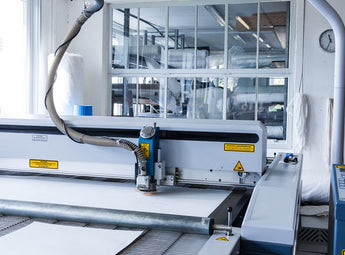
Using two powerful eurolaser L-1200 Conveyor systems, we cut synthetic and technical textiles up to 1800 mm wide and 12 mm thick – from one-off pieces and prototypes through to series production. The key benefit of textile laser cutting: with suitable synthetic materials, the process creates a thermally sealed cut edge that doesn't fray and can go straight into further processing.
✅ Why Choose Laser Cutting for Textiles?
Laser cutting offers clear advantages over mechanical cutting methods such as knife, plotter or die cutting in industrial settings. It's particularly valuable for technical fabrics, filter textiles or multi-layer materials, where it ensures consistent quality.
✅ Precision With Complex Contours
Even intricate or geometrically demanding shapes can be cut to millimetre accuracy. This matters especially for technical textiles, filter fabrics or functional textile components, where dimensional accuracy and repeatability are critical.
✅ Sealed Cut Edges on Synthetic Fabrics
When laser-cutting synthetic textiles, the cut edge fuses in a controlled way. This prevents fraying – an important quality factor in downstream processing such as sewing, welding, laminating or assembly.
✅ Contact-Free Processing
Since no mechanical pressure is applied to the material, there's no distortion. Even flexible or multi-layer textile materials keep their dimensional accuracy – ideal for demanding industrial applications.
✅ Reproducibility
Digital manufacturing processes deliver identical results – from prototype through small batches to full-scale production. This makes laser cutting for textiles a reliable option wherever consistent series quality is required.
✅ Cost-Efficiency
There are no tooling costs. Changes can be made directly in the CAD file, making textile laser cutting especially flexible – even with frequently changing contours or variants.
Laser Cutting for Technical Textiles – Our Focus
We specialise in laser cutting synthetic and technical textiles for industrial applications. Our strength lies in clean edge quality, reproducible results and processing roll goods via conveyor technology.
Many of these materials are also used in industrial process filtration, metalworking, or technical applications in environmental technology.
Suitable Materials
- ✔ Polyester fabric
- ✔ Polypropylene (PP)
- ✔ Polyethylene (PE)
- ✔ Polyamide (PA)
- ✔ Technical filter fabrics
- ✔ Synthetic nonwovens
- ✔ Technical felt (synthetic)
- ✔ Textile membrane materials
- ✔ Multi-layer textile composites (subject to review)
These materials benefit particularly from laser cutting, since the cut edges are thermally stabilised, and many synthetic fibres end up with a fray-free edge.
Outside the Scope of Our Laser Cutting Service
- ✖ Cotton (chars during laser cutting)
- ✖ PVC-containing materials
- ✖ Leather processing
- ✖ Pure engraving jobs
- ✖ Standard film cutting (only after individual review)
This clear focus ensures every project is executed to a technically sound, high-quality standard.
Technical Capacity & Machinery
For professional textile laser cutting, we operate two eurolaser L-1200 Conveyor systems. The conveyor system enables continuous processing of roll goods and ensures consistently high quality for series production.
Performance Data at a Glance
| Machines | 2× eurolaser L-1200 Conveyor |
| Maximum width | 1800 mm |
| Maximum material thickness | 12 mm |
| Length | Roll goods possible (continuous processing) |
| Processing | Contour cutting & series production |
| File formats | DXF preferred (PDF/JPG/sketch for reference) |
| Application area | B2B industrial applications |
Textile Laser Cutting for Industry & Trade
Our service is exclusively for business customers. We see ourselves as a manufacturing partner for companies that want textile components produced reliably and reproducibly – based in Germany, with short lead times and clear communication.
Typical Applications
- Filter fabric cutting
- Membrane discs
- Functional textile components
- Technical interlayers
- Moulded parts for mechanical engineering
- Textile components for environmental and filtration technology
- Custom industrial solutions (contour-based)
Laser cutting for textiles in Germany is increasingly in demand, as businesses favour precise, flexible, digitally controlled manufacturing processes – especially when short-notice changes or variants are needed. Many of these applications also feature in our industry solutions for industrial filtration.
How Your Project Works
01
Project enquiry
You send us your DXF file or technical sketch, along with material details (material type, thickness, roll/sheet goods, quantity).
02
Feasibility check
We review material properties, cut geometry and technical feasibility – including a note if a material isn't suitable for laser cutting.
03
Quotation
You receive an individual, project-based quote with transparent pricing.
04
Production
Manufacturing on our eurolaser L-1200 Conveyor systems – from sample parts to full-scale production.
05
Shipping
Delivery across Germany or collection in Werther (Westphalia).
Location & Nationwide Delivery
WINKLER is a B2B service provider for textile laser cutting in Germany. Our production site is located at 33824 Werther (Westphalia) in North Rhine-Westphalia. From here, we supply businesses across Germany.
Get Your Textiles Laser-Cut – Request a Quote
Looking for an experienced B2B service provider for laser-cutting technical textiles or synthetic fabrics? Get in touch about your project.
WINKLER GmbH
Location: Werther (Westphalia)
Phone: +49 (0) 5203 8828-0
FAQ – Laser cutting of technical textiles
Common Questions About Professional Textile Laser Cutting
Laser cutting technical textiles enables highly precise cuts with sealed cut edges at the same time. Particularly for filter fabrics, technical materials or industrial textiles, laser processing delivers clean results and reproducible quality, from prototype through to series production.
Which materials can be laser-cut?
Particularly with synthetic materials, thermal edge sealing creates a clean, fray-free cut.
What are the benefits of laser cutting over mechanical cutting?
This delivers precise cuts with consistent quality, even for complex contours or large quantities.
Is laser cutting also suitable for prototypes and small batches?
This process enables fast adjustments and short development times for new products.
What data is needed for a laser cutting job?
If no technical drawings are available, cuts can also be made from sketches or samples.


